With a booth nearly the size of a football field, SONY (www.sony.com) had numerous product announcements at the show designed for cinematographers and filmmakers. As expected, Sony released their new F35 digital cinematography camera system, which offers a new Super 35mm-sized CCD sensor and PL lens mount, and allows flexible use of 35mm cinema lenses. The camera is designed with the same platform as the F23 and like the F23, offers over- and under-crank capture (1-50 fps) and can dock with Sony’s SRW-1 deck to capture full-band-width RGB 4:4:4 HD data. Exactly one year after the debut of their popular EX1 camcorder. Sony debuted the PMW-EX3. Like the EX1, the EX3 offers three half-inch CCDs, full 1920x1080 resolution, native 24p support and records to dual SxS cards. Unlike the EX1, the EX3 offers interchangeable lenses, which obviously will be a big hit with shooters. The camcorder, which has a suggested retail price of $13,000, also features gen-lock and timecode in/out for multi-camera operation.
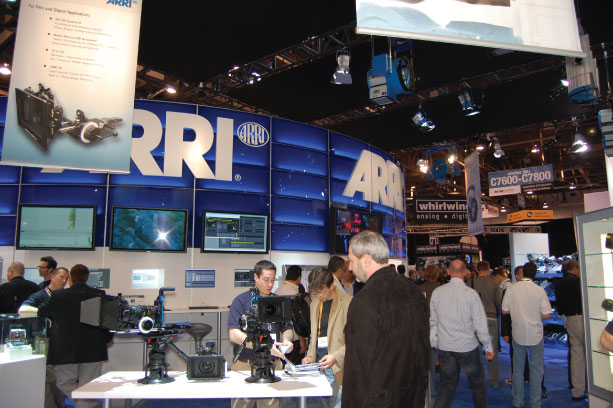
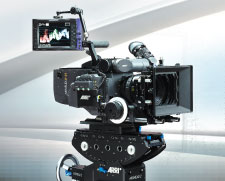
ARRI (www.arri.com) had a new and improved looking booth that displayed their impressive new slate of products that was announced a few days before the show in Los Angeles. The biggest announcement was an upgrade to their film style digital camera, the ARRIFLEX D-20. The ARRIFLEX D-21 has new improvement to the image processing engine, improved image quality, simpler operation and new accessories. Perhaps most notable were new output options that include a 2K raw data output mode (ARRIRAW T-LINK) and the use of anamorphic lenses. ARRI also introduced the ARRIFLEX 416 PLUS HIGH SPEED, which offers higher frame rates for slow-motion shots. ARRI has helped spearhead the rise in Super 16 filmmaking for indies and this offering only demonstrates their commitment to the format.
Like previous years, the RED (www.red.com) tent continued to generate the most buzz and longest lines at the show. [Instead of waiting in a two-hour line, I settled for their vague brochure.] The most anticipated RED release was their new pocket sized version of the RED ONE camera. The specs of the miniature camera, called the SCARLET, were very impressive, offering 3K, a new 2/3” Mysterium X Sensor, 1-120 fps, raw and RGB recording to dual Compact Flash cards, Wi-Fi control and more. Their other big announcement was the EPIC, which is a 5K camera that has a full frame Super 35 Mysterium X sensor. The camera weighs only 6 lbs and is compatible with most of their RED ONE accessories.
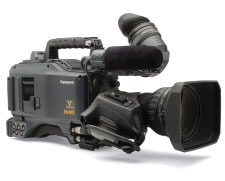
PANASONIC (www.panasonic.com) unveiled a new flagship model for their popular HD VariCam line. The VARICAM 3700 records full native 1920x1080 acquisition and independent frame recording with 10-bit/4:2:2 sampling. It also offers a 4:4:4 RGB dual-link live output. On a smaller scale, but just as impressive, Panasonic added a new camcorder to their AVCCAM line, the AG-HMC150. The camera, which looks similar to their DVX100B mini-DV camera, can capture 1080 and 720 HD of mpeg-4 AVC/H.264, which is a codec that many consumer cameras have adopted. The advantage of AVCHD is that it can provide much more bandwidth efficiency than the HDV mpeg-2 compression. In addition, P2 users will be excited to know that FUJIFILM announced that they are introducing P2 format memory cards in 16 and 32 gb capacities with a 64 gb version to follow later this year.
Also, there were a few new 3-D camera systems that made their debut. P+S TECHNIK (www.pstechnik.de) introduced their 3D MIRROR RIG, which offers the possibility to create stereoscopic films without the limit of a side-by-side system. The system was developed with an international team of 3-D specialists.
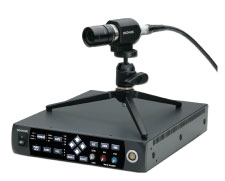
ICONIX VIDEO (www.iconixvideo.com) is also getting into the 3-D business and recently completed a 3-D film for Reebok with the use of their HD-RH1F camera system. They also introduced their STUDIO2K camera that will be used for motion picture exhibition, film-out and 3-D applications. The Studio2K is ideal for shooting scenarios that require very small, lightweight cameras without compromising professional image quality.
Next: Lenses and Filters |