|
|
|
|
 |
| |
|
|
CINE SADDLE |
|
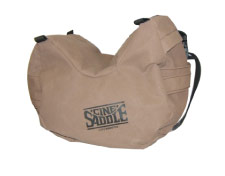
Cine Saddle. It’s a lightweight pliable camera platform that allows you to easily and quickly compose stationary shots from a multitude of varying surfaces. From your lap in a car, to the handlebars of a bike, to just about any surface that a hi-hat would take time to stabilize. This bag saves me time and allows me to capture more stable shots with the least amount of effort. In a pinch it even works as a quick hood mount. On a recent shoot for the World’s Funniest Commercial, the director, at the last minute, asked if we had a hood mount. Although it’s not my first choice in car mounts, the Cine Saddle came through in a pinch. We got the shot. The director couldn’t have been happier.
- MARK RITCHIE
www.cinekinetic.com |
| |
|
|
SCRIM JIM KIT |
|
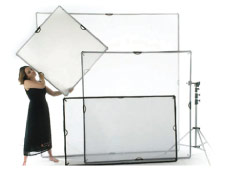
I end up in a lot of remote locations where I have to depend on the sunlight as my only source. So it is essential that I have a portable, efficient system to control the natural light. That’s where my Scrim Jim kits come in. They are lightweight and compact, which is important in today’s increasingly restrictive world of travel. Shooting docs does not excuse unflattering portraiture of your characters. You want your subjects to look good wherever possible, even in harsh environments. My Scrim Jim sets allow that while at the same time keeping things natural. I use the 6x6 with the stop silk as an overhead diffuser against the harsh midday sun. The material is light enough to do a good job on the face but not bring down your levels so much that your backgrounds burn out. The 4x5 frame works as either a bounce/fill or a soft edge, bringing light into your subject at eye level. A little bit of control can go a long way in improving production value!
- JAMES BALL
www.scrimjim.com |
| |
|
|
WOODYLIGHT |
|
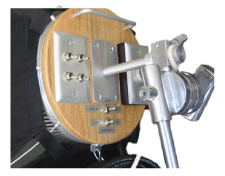
The WoodyLight is a softlight many generations perfected from the simple purpose-built showcard, socket and zipcord unit. It features a bi-pin socket for a 1K EGT globe and 4 Edison base sockets all mounted on a round aluminum and wood frame. A switch allows you to choose either the 1K globe or a combination of standard bulbs (photo bulbs like BA-1s or 213s) and route them directly or through a dimmer on the back of the unit. I use a Westcott softbox and control grid on the front to give a smooth, wrappy light that's great as a key or fill light in an interview setup. I love the way the WoodyLight's output gets into the subject's eyes and brings life into their face. It’s quick to setup and easily adjustable on-the-fly. It packs into a milk-crate case and is easy to travel with. Light is the tool that's constant in whatever type of production you're shooting, onto whatever method of capture. This light always has a place in my kit.
- JEFF BAUSTERT
www.woodylight.com |
| |
|
|
RAINGEAR |
|
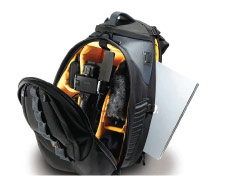
Raingear – for both camera and operator. Back in the day as a first assistant (N.Y.C. 1980s) I always carried that heavy-duty yellow rain gear from the marine store, just in case the director decided it would look better with a little rain and called for the water trucks and towers. Today's higher-tech and lighter-weight alternative would be "Frogg-Toggs" from an outdoor outfitter. For the camera (mine are all video now), I use Kata Rain Covers. They are a generic fit and therefore are not limited to one specific camera, as are some other brands. They allow operating from either shoulder or tripod with the cover on. I imagine, but do not know for sure, that one of them could be made to fit a 16SR/416 or similar camera. I also have one for my Nikon DSLR.
- STEVEN COHEN
www.kata-bags.com |
| |
|
|
DEDOLIGHTS |
|
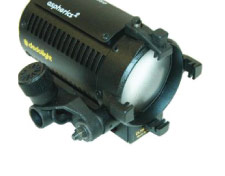
Dedolights for their small size to luminance ratio. I use the DLHM4-300 heads, which are 150 watt with built in dimmers and no separate ballast – usually in a kit of three with barn doors and scrim sets. They are quite bright yet you can plug a whole kit into one circuit with no problem. They give you a good smooth field and are easy to shape with their barn doors, usually eliminating the need for flags. At full blast, their color temperature is a little cool so with ¼ or ½ CTB, they are about the color of warm sunlight and mix in well when you have daylight in a scene. They are super for back lights and lighting the background – and bounced into a little card – they can even serve as a key.
- CORT FEY
www.dedolights.com |
| |
|
|
WESTCOTT 6-IN-1 |
|
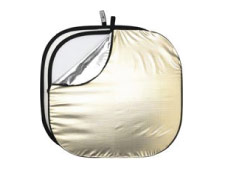
My Westcott 6-in-1. It has (1) one-stop diffusion panel, (1) two-stop diffusion panel and (1) slip cover that is silver, sunlight, gold and white. And it all fits in its pouch. I keep a few grip clips to use to attach it to c-stands, trees, signposts, whatever it takes. The “6-in-1” refers to the six options it gives you. I love it! It gives me so many options with just one collapsible system that fits in my run bag or suitcase. It has travelled with me all over the world giving me great soft bounce light and overhead silk wherever I need it. It has gotten soaked with rain and mud in the Cook Islands, Fiji, and rural China, gotten very sandy on the beaches of Rio, and has acted as a wind-break for a long lens shot in
Argentina.
- SHANA HAGAN
www.fjwestcott.com |
| |
|
|
MANFROTTO 682B MONOPOD |
|
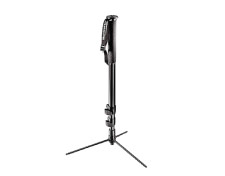
Aside from lights that travel well and give me what I need in the most extreme situations, one of my most important tools is a monopod. I now use a Manfrotto 682B with a screw out stand in its base. It is nearly six feet tall and can support a VariCam. At its shortest mode I use it on DVX’s or HVX’s as a stabilization pole. I’ve run full tilt with Detroit SWAT during raids and have had amazing steady shots! You can easily get in and out of cars (easier than with a Fig Rig) while still holding a shot. You can elevate your camera a good six feet in the air, or over a crowd looking down. Or invert it and screw it into the top of the camera and get amazing ground level shots.
- TERRY PRATT
www.manfrotto.com |
| |
|
|
|
|
|
|
|
|
|
|