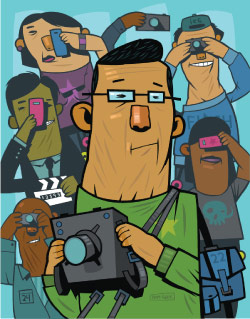
What if the official set photographer brought a Millennium XL to the set and started shooting cool shots? Or pulling focus? Or changing the lighting? He or she would rightly be fired in less time than it takes to say “oops.” But increasingly, Local 600 still photographers are finding other crewmembers, occasionally even other Camera Guild members, performing their function—taking still photos on set, often of talent and frequently even as the motion picture cameras roll. This has been a problem for the authorized Guild set photographers for some time. The practice has often interfered with their getting the shots needed to publicize the film. But today, with still and even video cameras the size of a RAZR mobile phone, the problem has become more widespread with delivery systems that can get these images into tabloids in days or onto websites in minutes. Studios, producers, talent and reps are starting to realize just how dangerous this widespread issue of unauthorized photography can be.
ICG National President Steven Poster, ASC, takes the issue very seriously. “The Guild still photographer,” he points out, “is the only one on set who is there to get the images that represent how the film should look—how the producer wants the film to look—not some extra or crewmember hired for another purpose and grabbing some terrible image on their cell phone. Producers want their show represented in the best light and it makes sense that they shouldn’t have unauthorized cameras on the set.”
In fact, some have. One science fiction show reportedly got burned last season when a day player production assistant uploaded unauthorized images from the set to a fan site, revealing spoilers and presenting the show in a negative light. Photos of an actress’s highly emotional cell phone conversation between takes on her crime series made it into a tabloid. It is because of events like these that unauthorized cameras have been banned from the set of the Tom Cruise Nazi era drama Valkyrie.
“When producers have a professional there to take pictures, to work with the publicity department to present the movie in the best light, why would they want other people shooting pictures?” Poster asks rhetorically. “I’ve seen films that I photographed represented terribly in pictures that were taken by someone other than the authorized unit photographer.”
Unit publicist Sheryl Main, who has been in the business a long time, recalls that the pervasiveness of unauthorized photography started exploding just over four years ago on Terminator 3: Rise of the Machines. “Every time Arnold walked on set it seemed like every crewmember had a camera phone. I went to the producers and asked them to put on all the call sheets: ‘No cameras. No camera phones. No unauthorized taking of photos. They were happy to do it but at first, people still didn’t listen. When you’re trying to keep things under wraps, you don’t want people e-mailing pictures to their friends who e-mail them to their friends who put them up on the Internet. It can become a zoo and we lose complete control how we’re presenting the film.”
Fortunately, Main recalls, the actor-turned-governor was savvy to the problem so he would check with her whenever he saw a lens (or camera phone) not belonging to the authorized photographer aimed in his direction. That kind of support can at least help keep some kind of control over the situation. “Arnold would notice a camera out of the corner of his eye and ask me, ‘Why is that person shooting pictures? ‘Why does this person have a phone out?’ We worked in concert.
“I think we can make a difference if we at least let producers know the problem,” she continues. “The people on set to do publicity are the gatekeepers of how the film is perceived before it is seen and we try to get producers to work with us. Many do see that it is to their benefit to prohibit unauthorized photography. In some cases people just shoot pictures out of ignorance. Maybe they’re guests on set and they don’t know any better. On T3, I started checking all cameras and after about the third week, we didn’t have a problem any more.”
Likewise, Sylvester Stallone provided the kind of high-power support to Main’s mission during the production of Rocky Balboa that made it possible to control unauthorized set photography. “I was a mad dog on that set,” she laughs. “He [Stallone] was adamant about having no unauthorized pictures on the set and was very helpful about pointing out anyone he saw with a camera or cell phone.” She believes that some problems occur simply out of ignorance and notes that when she explained to the crew how important it was to control the situation, they were very cooperative, even helping her spot people stealing pictures on set rather than doing it themselves as other crews have been known to do. “I’ve seen PAs taking pictures and then plead ignorance,” she observes. “If they didn’t know they shouldn’t be taking pictures with their cell phone on a movie set, they shouldn’t be on a movie set.”
The problem isn’t new for Main but dealing with it requires more vigilance and more of her time than it did when cameras had a bigger, more obvious presence and before images could be instantly uploaded. “I’ve taken film out of people’s cameras,” she says. “I’d get names and addresses and have it processed. If there were pictures from the set, I’d remove them and then I’d send any personal photos. Now, a picture can be on [celebrity gossip site] TMZ five minutes later.”
“My feeling is that this problem is more complicated than a lot of people think,” says Henri Bollinger of Sherman Oaks-based Henri Bollinger PR. “We have to get clearances from actors or their reps for every shot taken on a set. The unit photographer might take 3,000 pictures and something like 35 get approved. If an unauthorized picture of an actor ends up in print, it can raise legal issues.
“It’s a growing problem,” he adds, “for us and production companies. But it’s very important to figure out who can do the policing.” Bollinger says that his personal suggestion would be to have Local 600 shop stewards report the names of unauthorized still and video photographers who come on sets to the Guild and have the Guild take action. Set photographers and publicists alone, he says, can’t be the only line of enforcement because even in situations where producers understand the problem and prohibit unauthorized photographs, they are not always on the set to enforce the edict.
To Poster there is also a very essential reason why it is a bad idea for anyone to be shooting still photos on set other than the person hired by the production to do so. “Nobody should be doing someone else’s job,” he says. “The unit photographer is the person on set who is there to get the images that will represent the film and do so without interfering with the work the actors and other crewmembers are doing. It’s a difficult job. I realize there are times when someone else might need to have stills for legitimate purposes but they should make use of the unit photographer whenever possible and get authorization from the production so they are accountable.”
Poster, himself a longtime still photographer, recalls one of his very first jobs on a set, working for Owen Roizman, ASC, as a second unit operator on the Western, Return of a Man Called Horse. “I was completely green at the time,” he recalls, “and at one point I wasn’t operating and I have a background in still photography and someone said, ‘Why don’t you go take some shots?’ So I did and I wound up right in Richard Harris’s eye line and he just about killed me. I realized right there that this wasn’t my job, it’s not why I was there and I’ve never done anything like that since. “Nobody on the set should get in the way of the unit photographer,” Poster sums up. “Work with them and let them do their work. It is to everyone’s benefit.” |