|
|
 |
|
 |
|
|
|
|
|
|
|
|
OCTOBER CONTENT:
|
|
|
|
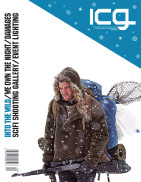
INTO THE WILD, DP Eric Gautier, AFC
By David Geffner
WE OWN THE NIGHT, DP Joaquin Baca-Asay
By David Heuring
DAMAGES, DP David Tuttman
By Pauline Rogers
PRESIDENT'S LETTER
by Steven Poster, ASC
CREW VIEW, 1st AC Greg Johnson
By Bonnie Goldberg
UNAUTHORIZED SHOOTERS, Focusing By Jon Silberg
STILL PHOTOGRAPHY AND PUBLICITY
By Jon Silberg
|
PARTNERS ON THE SET, Tas Michos, ASC
and Mitch Dubin, SOC
By Pauline Rogers
EVENT LIGHTING
By Bonnie Goldberg
SCIFI SHOOTING GALLERY
TRIP TO ROCHESTER (KODAK)
By Sol & Betty Negrin, ASC
MERV GRIFFFIN TRIBUTE
By Dale Olson
SOC/ICG J.L. FISHER MIXER |
|
|
|
|
|
|
 |
|
ERIC GAUTIER, AFC SHOOTS OFF THE BEATEN PATH FOR INTO THE WILD
By David Geffner
Photos by Chuck Zlotnick |
|
 |
|
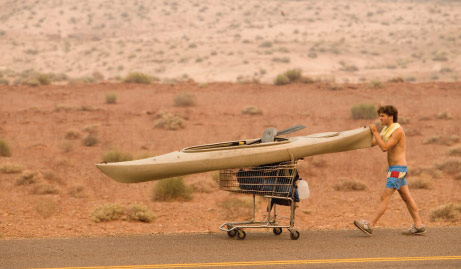
Jon Krakaeur’s best-selling book, Into the Wild, tried to decipher why Chris McCandless, a 23-year-old college graduate from an affluent East Coast family, spent two years road-tripping across the nation to Alaska, where he walked off the paved road into the bush, only to be found dead by moose hunters four months later. The book obsessively retraced his odyssey away from civilization (McCandless abandoned and stripped his car of its license plates, burned his cash and social security card, and put a hold on forwarding mail so his parents couldn’t find him), and into the natural world. Although he never lingered too long, McCandless touched many lives along the way: an aging widower in the California desert, a rowdy wheat harvester in South Dakota, a hippie couple in the redwoods, among others. By the time a Fairbanks electrician dropped Chris (calling himself “Alex”) off at the Stampede Trailhead, outside Healy, Alaska, with not much more than a .22 caliber rifle and a ten-pound sack of rice, he’d amassed a resume of near-death experiences: kayaking down the Colorado River into Mexico, hopping freight trains in the Southwest and being homeless on the streets of downtown L.A. But as he entered Denali National Park with no compass, ax, or weatherproof gear, his chances for survival were slim. As Krakaeur’s gripping read makes clear, all McCandless (who worshipped the writings of Tolstoy, Thoreau, and Jack London) had about him when he walked into the wild was a burning desire to test his basic instincts in a place where character is revealed (or more likely shattered) by nature’s lack of mercy.
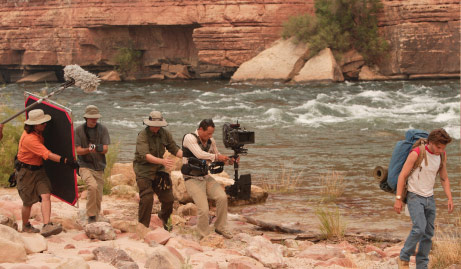
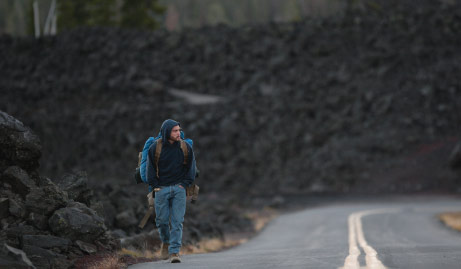
Into the Wild, the new film based on Krakaeur’s book, from writer/director/producer Sean Penn, takes an equally quixotic journey. Working with cinematographer Eric Gautier, AFC, Penn spent days humping through terrain so formidable, the cameras, lenses, and batteries had to be brought in via backpacks. Penn’s crew, ranging in size from a small handful to dozens of technicians, went everywhere McCandless had gone, encountering conditions that ranged from freezing Artic snow, to wind-blasted, sun-drenched desert. They shot for more than six months in eight states, and visited Alaska four separate times (to capture every season). Gautier, who is based in France, logged forty-six separate airline flights during production! The results are breathtaking and as far off the creative roadmap as its subject matter. The story begins with McCandless (played by Emile Hirsch) walking into the bush, and spins backward through the long, strange trajectory of his road trip, before culminating with his death in an abandoned school bus deep in the bush. Shot in 3-perf, Super 35mm (the longer 3-perf magazines helped avoid reloading in the extreme locations), with three different camera systems (the primary system being the super-portable Aaton 35-III), Into the Wild takes bold, even reckless chances. Like McCandless, the filmmakers adopted the credo: if the outcome is pre-determined, the journey presents no true challenge.
“Sean picked me to do this film after having seen my work in The Motorcycle Diaries,” notes Gautier, on vacation in the Normandy countryside. “That was also a road movie. But where The Motorcycle Diaries was about two young men going out to meet and embrace civilization, Into the Wild is the opposite. Chris’ goal was to leave civilization behind and embrace the kind of nature that is beautiful on the surface, but deadly in its belly. And, in fact, that visual contradiction was the key to our movie. We were always juxtaposing panoramas of Alaska, or South Dakota, or the Colorado River, with intimate close-ups of Chris and the journey in his mind. We really wanted the viewer to feel what he was feeling, right up until the very end of his life.” Gautier, who had success using Fuji’s new line of Eterna stocks (500 Tungsten and 250 Daylight) on last year’s Paris-based love story, Coeurs, wanted a tough and gritty, yet colorful look for Into the Wild, that was also filled with the kind of texture only a high-speed film stock can supply. Most of all he wanted to avoid a glossy sheen that would look too much like a magazine cover’s version of the backcountry. “People associate Fuji stocks with a pastel look that doesn’t have much saturation,” Gautier explains. “But I found the newer film to have plenty of contrast and color range. I forced the development to help increase the contrast, and used Zeiss Ultra Primes, which are very contrasty lenses. With all the available lighting, and handheld work, there is a sense of discovery, like an on-the-road documentary. But at the same time, there is also some very sophisticated dolly, Steadicam, and helicopter work that helped us achieve this macro/micro theme.” |
| |
|
 |
| |
|
Flexibility and improvisation were the main keys to shooting in such intimidating natural conditions. The opening frames of the film show Chris McCandless alone on an Alaskan mountain peak, at one with nature in her most untainted state. “It was winter and there was snow everywhere,” Gautier continues. “We flew the helicopter up to the top of the mountain, and Sean told Emile to get out and improvise. We were with John Trapman, who was operating the helicopter camera, and we basically flew various passes around Emile, trying to capture this sense of euphoric mystery he’s experiencing. There was no shot list, storyboards, or visual plan to the scene, and it turned out amazing.”
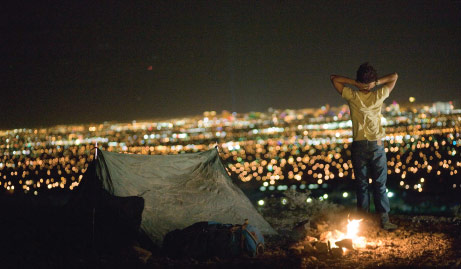
Likewise for a key location later in the film called “Slab City,” a real-life enclave near California’s Salton Sea, where residents use campfire and small generators for light. “We did a lot of handheld, improvisation with the real people who lived there,” Gautier explains. “I used 500-watt practicals and fluorescents just to fill in the background and allow Sean total freedom with the camera. During the day, Slab City was very hot and dry, with the sunlight bouncing off the concrete, so I overexposed a lot to capture that sensation.” The DP says this decide-at-the-last-minute approach meant mostly lighting scenes through the lens. “The slightest change in direction, toward or away from a cloud or sunlight, would alter everything, so we couldn’t build large lighting schemes that would be too difficult to move or change,” he notes.
Coroner reports posited that McCandless died from accidentally ingesting poisonous berries, and Penn wanted a strong, almost violent sunlight to penetrate the bus for the film’s climax, when Chris’ body gives way—so Gautier hauled in four 18Ks. “Although he’s in the midst of the most astounding natural landscape, he’s starving to death and can only see a few feet ahead,” Gautier adds. “To create the image and color distortion that would illustrate this condition, we used swing and tilt lenses with the ARRICAM LITE and 435 systems, as well as some slight diffusion and warm filtration.” The shallow depth of field with the swing and tilt lenses eliminated any hope of critical focus. Gautier notes that Penn had the idea of having a grizzly bear pass very near to Chris and then simply move on. (The bear was trained and worked behind an electrified wire perimeter.) “At that point,” says Gautier, “he’s so frail, even the bear is not interested. He’s dying and no longer part of nature.” The final shot of the movie sums up the sad contradiction at the heart of the story, where the same nature that offered freedom, has, ultimately, become a prison. “It was done in two shots,” Gautier explains. “The first part was on an Akela crane, which has the longest arm available at 87 feet. We then picked up the following day with a helicopter at precisely the same point where the crane stopped. It was a feat of logistics to get this crane out into the bush. I had to pick the right position |
| |
|
 |
| |
|
because it was impossible to move and build it again, once we finally got it there.” The shot begins on Chris’s wide-eyed death mask gazing up through the roof of the bus at the sun in the sky, and pulls up and away until both are mere dots in a vast northern landscape. Gautier used an Angenieux Optimo 24-290mm, T2.8 zoom lens, as the Akela crane pulled away from the dead man’s stare. Poles were raised to measure the point where the crane stopped, and images were compared from crane to helicopter to help match frame-lines. “The two movements were blended together digitally by Entity FX,” Gautier adds. “They asked us to get as high as possible with the crane shot. The key was to go wider on the helicopter camera because that made it easier to re-frame and match.”
Gautier says one of the reasons he was able to take so many risks, i.e. shooting in the Arizona desert at night when Chris is kicked off a freight train and beaten by a rail-yard cop who holds a single swinging lantern as the source light, was the film’s editor, Jay Cassidy, who visited locations with his laptop and portable projector. “In a film this large and complicated, editors often ask for specific coverage, i.e. master, close-up, to help cut the scene,” Gautier notes. “But Jay never asked Sean or me for anything. Given all our different styles and light sources, we weren’t sure how our risks would pay off until Jay showed us. He gave us the confidence to soar.” A good example of that synergy is when Chris arrives in downtown Los Angeles. Shooting at up to 150 fps with the 435, and handheld in the streets with a crude, gritty style, Gautier calls the sequence “totally different” than any other in the film. With his long, fast lenses, the DP was again battling against a shallow depth of field. “I tried to shoot between 2 and 2.8,” he recalls, “because I didn’t want the background to go completely soft and abstract.” The urban grime and paranoia that Chris drifts through (for the first time in his life) is brilliantly played out in a series of stop-motion step frames that blends Gautier’s down-and-dirty cinematography with Cassidy’s evocative editing. Another example is early in the movie when McCandless graduates from Emory University and tells his father he’s not going to law school. “William Hurt (who plays Walt McCandless) clearly doesn’t understand his son’s actions,” relates Gautier. “The room appears quite soft and beautiful, but it’s a very uncomfortable moment.” Gautier freely mixed sunlight coming into the |
| |
|
 |
| |
|
| |
restaurant throughout the day, with small tungsten practical lights on each table. The camera is on a circular track, panning and spinning among the family (Jena Malone plays Chris’ sister, Carine, Marcia Gay Harden plays his mother, Billie). Wherever the camera’s axis was pointed determined the ratio of tungsten to daylight in the scene; and no two shots were ever repeated. “Most people would have made it match in the DI,” Gautier notes. “Jay made it all cut together without matching any of the light sources, which is how I always envisioned maintaining this tension that underlies the scene.”
Into the Wild, as the title suggests, is about one man’s journey into the physical and psychological places humans rarely venture. Not only did that mean capturing remote locations, far off the paved road, but also the wildlife McCandless encountered. Gautier, who is more at home shooting in the cafes of Paris, had never shot wild animals before. “Patience is the most important thing,” he recounts. “Sometimes we’d hike all day just to shoot a single eagle in flight.” The animals proved to be another reason why a fast film stock was needed—with a 150-600mm Canon zoom, and an extender that turned it into a 300-1200 lens, Gautier was still able to get decent depth of field even on a dark and cloudy day. “The ultimate challenge on this film, aside from the sheer logistics of moving the production unit so often to so many different types of locations,” he concludes, “was portraying the places Chris experienced as they really were. We didn’t want to show nature as being pretty or abstract. We wanted each place Chris visited to feel very tough and real. To do that we had to get out of our professional comfort zone and really be surprised every time we turned on the camera.” |
|
|

ICG @ IBC

alum est icke lorum dalum est icke lorum dalum est icke lorum dalum est icke lorum dalum est icke lorum dalum est icke lorum dalum
www.ibcexpo.com |
| |
| |
|
|
|
|
|
|