NOVEMBER CONTENT:


HOME OF THE BRAVE, DP Tony Pierce-Roberts heads home.
By Pauline Rogers.
PRESIDENT'S LETTER
by Steven Poster, ASC.
BOBBY, DP Michael Barrett takes aim.
By Bob Fisher.
UGLY BETTY, DP Ross Berryman, ASC dresses up.
By David Heuring
OPERATING TIPS
by Bill O’Drobinak


TIPS & TOOLS, An eclectic group of tools designed to let the cinematographer get that incredible shot with less time and effort.
DOCUMENTARY CINEMATOGRAPHY

BUDDY SQUIRES RECEIVES INTERNATIONAL DOCUMENTARY ASSOCIATION’S LIFETIME ACHIEVEMENT AWARD

CAMERAIMAGE FESTIVAL

THE PHILADELPHIA MEGA DIGITAL WORKSHOP

ROBERTO SCHAEFER, ASC HELPS TRANSLATE THE KITE RUNNER TO THE BIG SCREEN

By Bob Fisher
Photos by Phil Bray

Nothing and everything in his life prepared Roberto Schaefer, ASC for translating the words in David Benioff's script for The Kite Runner into images that faithfully depict a sense of time, place and the emotional flow of the story. The project was his seventh collaboration with director Marc Forster, including such films as Finding Neverland, Monster's Ball and Stranger Than Fiction.

"Marc and I were completing postproduction on Stranger Than Fiction when he asked me to read the script for his next project," Schaefer recalls. "I cried while reading the script. It's a very personal drama about being true to yourself and to your friends, with classic themes of revenge and betrayal."

Benioff's screenplay was based on a best-selling novel written by Khaled Hosseini, an expatriate of Afghanistan. Schaefer also read the book, which provided a nuanced picture of how the tide of history that swept over Afghanistan after the Russian invasion and rise of the Taliban during the 1970s affected ordinary people in Hosseini's native land.

The film paints a rosy picture of a boy's privileged life in Kabul before the invasion. Amir lives with his father Babba because his mother died during childbirth. Their needs are attended to by a servant and his son, Hassan, who is also Amir's loyal and doting friend.

Amir is a champion kite fighter, which was a popular sport in Kabul. The goal is to soar high and use shards of glass embedded in the string to send opponent's kites falling to the ground. Hassan is an illiterate, kite runner who has a talent for retrieving opponent's fallen kites as trophies for Amir. Their friendship is scarred when Amir fails to come to Hassan's aid when a gang of thugs attacks him.

After the invasion and the chaos that ensues, Amir and Babba make a dangerous trek into Pakistan on their way to a new life in northern California, where they connect with other expatriates from Afghanistan. Hassan and his father are left behind to fend for themselves.

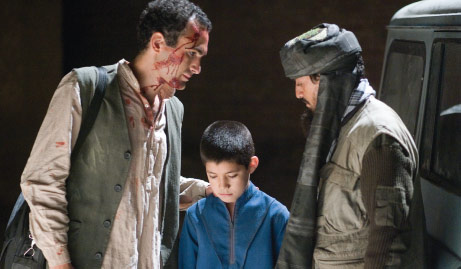
Amir graduates from college, gets married and is on the path to becoming a successful novelist. He agrees to fly to Pakistan to meet an old family friend. That is when he learns that the Taliban murdered Hassan, and that his son is in mortal danger at an orphanage in Kabul. Amir has to make a moral decision about whether to resolve his debt to Hassan.

A-camera first assistant Zoran Veselic, A-camera operator Jim McConkey, dolly grip Tim Christie, director Marc Forster and video assistant Zacharias Katz execute a difficult tracking shot.


Schaefer and Forster agreed during their first meeting that the landscapes, cityscapes and streets in Afghanistan and California were more than backgrounds. They decided that the film had to be framed in 2.4:1 aspect ratio in either anamorphic or Super 35 film format.

The need for digital intermediate (DI) postproduction was also evident, because they anticipated that some 400-500 visual effects shots, including background plates with landscapes and architecture, as well as CG images that would have to be composited with live-action shots.

Schaefer flirted with the idea of shooting big exterior scenes in anamorphic format, other shots in Super 35 and blending the images during DI. He made a three-day trip to the Vantage facility in Weiden, Germany, before a decision was made about the production format. He shot tests comparing the new Hawk anamorphic lenses and spherical lenses in Super 35 format.

"I fell in love with the Hawk lenses when I saw the tests projected," he says. "You can feel as well as see differences in emotional impact, but I decided they were too slow and big for scenes at some interior locations, which were only 6-by-8 feet."

They determined that using two formats would be impractical, and decided to shoot The Kite Runner in Super 35 format with spherical lenses. During their earliest discussion, Schaefer and Forster visited a bookstore where they found and photocopied pictures of locations in Afghanistan. Their other visual references were pictures taken during location scouts and photographs, narrative films, and Dutch documentaries produced in Afghanistan during the 1970s. Forster assembled a book of pictures that he shared with the entire creative team.

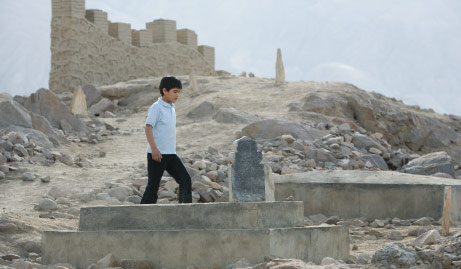
A decision was made to produce scenes set in Northern California at practical locations in that region, including a grassy spot in Berkeley for kite flying sequences, cemeteries in Piedmont and Oakland, Treasure Island in the San Francisco Bay, Newark and Hayward.

"Marc and the producers were thinking about Morocco, China and Turkey as locations for filming scenes set in Afghanistan," Schaefer says. "After they decided on China, I spoke with Bennett Walsh, one of the producers, Herb Ault (grip) and Ian Kincaid (gaffer). All of them had worked on Kill Bill in China. I also got useful insights from Dan Mindel, Stuart Dryburgh and several camera operators who have worked on commercials in China."

They did technical scouts of locations in Northern California, in Kashgar, Tashkurgan and the Pamir Mountains in China. Kashgar, which doubled for parts of Kabul during the 1970s and early 2000s, is in a desert area that gets very hot and dry

   
DP Roberto Schaefer, ASC and director Marc Forster scouted locations in Northern California, in Kashgar, Tashkurgan and the Pamir Mountains in China.

with wind and dust storms in summer, and very cold and dry in winter. They also decided to shoot some scenes on two sets built on stages at Beijing Film Studios.

Schaefer arranged to bring key members of his crew from the United States, including A-camera/Steadicam operator Jim McConkey and first assistant Zoran Veselic. When he heard that Richard Bowen, ASC and his wife were temporarily living in Beijing doing volunteer work with orphanages, he recruited him to organize and lead a second unit crew. Simon Jayes joined the crew and operated the B-camera in Northern California.

Schaefer dispatched Veselic to the new ARRI rental facility in Australia to check out and prepare the camera gear. It included ARRICAM Studio, ARRICAM Lite and Arriflex 235 cameras, a range of Zeiss Master Primes, and a Hawk 150-450mm, Zeiss 15.5-45mm, and Angenieux Optimo 24-290mm and 17-80mm zoom lenses.

The Kite Runner inaugurated Cinelabs Beijing, which did the front-end lab work in China. The new lab is a joint venture between Kodak and the Beijing Film and Video Laboratory, a wholly owned subsidiary of China Film Group.

Forster made a second trip to Kabul to verify and reinforce his initial impressions. Afterwards, they prepared diagrams and shot lists. Schaefer used a global positioning device to predict angles of sunlight to guide decisions about times and directions of photography.

"Where you put the camera, the angle and framing are intuitive decisions, based on what you and the director want the audience to see and feel," he says. "I tried to keep the light realistic-looking in our few big night exterior scenes, cool white and ambient. We also created puddles of light on the ground when street lamps are seen in scenes. I tend to use soft balloon lights that don't have to be motivated when I'm shooting desert scenes at night."

They had an ambitious 63-day shooting schedule. Schaefer emphasizes that first AD Michael Lerman played an important role in the collaborative process.

"You depend on the AD to get everyone in the right place at the right time," he says. "This was our fourth film together, so we were on the same page from the beginning. The Chinese AD also did a great job getting the extras ready and rehearsed."

Schaefer described the visual style as "somewhat subjective," as though the audience is unobtrusively peeking through a window and watching a drama unfold. There are various flashback and flash-forward scenes that take place in different seasons in periods ranging from 1971 to 2001. He cites a scene set in San Francisco in December 2001, which called for a cooler, less saturated look. The next shot was a flashback to 1971 during a very warm summer.

There are several big exteriors, including a night scene with hordes of Russian soldiers marching through the otherwise deserted streets of Kabul, and another one of a huge crowd at a soccer stadium. There were about 1,000 extras in that scene. They were seamlessly multiplied in visual effects to make it look like a crowd 20,000 to 30,000 cheering people.

Schaefer chose to cover most dramatic scenes with a single camera. He notes that many interior locations didn't have room for two cameras. He used two and occasionally three cameras to cover scenes with groups of children and big exteriors, including some with 1,000 or more extras who had rehearsed their movements with the Chinese AD.

As the story evolves, the color palette becomes cooler and a little desaturated with a grayer look compared to scenes that were set in Afghanistan before the Russian invasion.

Schaefer chose to work with a palette of three KODAK VISION2 color negative films. He made painterly decisions to record images on (100T) 5212, (200T) 5217 or (500T) 5218 stocks, which have specific imaging characteristics.

"Knowing that we were going to do a DI influenced the way we shot in some situations," Schaefer says. "We were shooting scenes in Kashgar in October and November when there was no direct sunlight. We wanted the softer look of winter light, but the Earth was rotating and the angles and intensity of sunlight were changing. Most of those times, I could use cloth to flag direct sunlight and soften it, but there were times and places when and where I couldn't do that. I said, 'Keep shooting, I'll clean it up in the DI.'"

There are nuances weaved into the visual grammar of the story that are meant to be transparent to the audience. Schaefer


explains that there is a little more grandeur in camera movement in Afghanistan during scenes set in the 1970s than later in the story.

"The crane movement in the 1970s is a little more dramatic, and there are more tracking shots on a Steadicam or dolly," he says. "Camera movement is more truncated during the later periods without it being too obvious. There are a couple of handheld shots. It's subtle, but I believe that it feels different to the audience on a subconscious level."

The authenticity of the kite flying and kite fighting scenes are essential threads in the fabric of the story. Forster and the producers recruited Basir Beria to come to Kashgar to oversee production of the kites made by the art department. He also trained the young actors to fly them. Beria began flying kites when he was 8 years old in Afghanistan. Like the fictional Amir and Babba characters in the film, Beria and his father escaped after the Russian occupation and resettled in California. He has won more than 15 international kite flying competitions.

There are no textbook directions for shooting a film like The Kite Runner. Everyone does it differently, based on his or her taste, intuition and experience. Schaefer has lensed documentaries in challenging environments in Italy, Egypt, Peru, Colombia, Brazil and the New Guinea rainforest. He says that taught him to react to moments when unplanned things happen.

"When you work on a feature film, the actors always bring something of their own to every scene that isn't going to be repeated in exactly the same way twice," he explains. "You have to recognize those magic moments and be ready to catch them on film."

Schaefer emphasizes the importance of their ability to watch projected film dailies during their first month or so in China. They had an ARRI LOCPRO Film Projector set up in a hotel room in Kashgar. The projector was used to evaluate the lens tests that he had shot in Germany, and for film dailies during the first two to three weeks of production in Kashgar.

"That really helped because it allowed us to see film images projected on a big screen," Schaefer says. "It was wonderful watching film dailies together. The lab did beautiful work. The rich look of the film gave everyone a good feeling about what we were doing together."

LaserPacific in Hollywood provided DVHS high-definition dailies for Schaefer and DVD dailies for Forster and everyone else during the rest of production. Schaefer had worked with dailies timer Bruce Goodman on previous films, so they had established a verbal shorthand.

It took too long to fly dailies to China and deliver them to Kashgar, so they tried using the Internet. The connections weren't always reliable, so they worked out a system where Schaefer documented scenes on digital stills and used the Gamma & Density 3cP color system to correct selected shots. The system consisted of his personal computer loaded with 3cP software and a monitor that was calibrated by Gamma & Density. Schaefer posted his corrected still images on the LaserPacific FTP website, and Goodman used them as visual references for timing dailies. In turn, Goodman posted selected images on the FTP site for Schaefer the same day that he corrected them.

"I saw them in my hotel room at night on the same day that he did the work," Schaefer says. "That proved to be our most reliable and effective form of communication."

The Kite Runner was Schaefer's fourth collaboration with LaserPacific DI colorist Mike Sowa. Their other films were Stranger Than Fiction, Stay and For Your Consideration.

"Roberto had a very clear picture of the looks he envisioned," Sowa says. "I knew what he meant when he said, 'Make the sky a little darker or mute the colors a bit.' I got a clearer picture when we timed the preview together. That gave me a roadmap for prepping the DI."

The conformed negative was scanned at 4K resolution, and down-rezzed to a 2K proxy file for the DI timing sessions. It was an interactive and collaborative process. The images were projected on a cinema-sized screen, and Schaefer told Sowa what changes he wanted.

"There are three main actors who are on the screen together in different periods, and they have very different skin tones," Schaefer says. "One of them tended to go a little pink on film, another was a little green, and the third one was sort of yellowish. We balanced those shots to look natural. We also desaturated some of the greens in trees and grass. There were scenes that we filmed at dusk that are supposed to be happening at night, so we darkened the sky a bit. We also touched up shots for moods and seasons."

The Kite Runner was produced and distributed by DreamWorks, SKG.