|
|
|
|
 |
|
“The XDCAM EX series, with its full HD picture quality and system, is a powerful tool for boosting quality and efficiency in an array of HD production applications,” says Bob Ott, Vice President of Optical and Network Systems for Sony Electronics. “It is also compatible with a broad range of non-linear editing systems. “Combined with the ability to capture and transfer footage using ExpressCard technology—the new standard for PC card interface—I believe this new camera will prove to be a very reliable and flexible compact camcorder for HD video production.”
The new model expands Sony’s XDCAM line of tapeless production and acquisition systems. The camera uses Sony’s newly developed SxS PRO solid-state memory as its recording medium. The memory card delivers up to 800mbps of high-speed data transfer, enables non-linear capabilities like instant random access and file-based operation. With two 16gb memory card slots, the camcorder can record up to 100 minutes of high-quality HD footage at 35mbps, or 140 minutes at 25mbps.
“The large 1/2-inch type image sensor can capture images with a shallower depth-of-field, allowing for more creative freedom of expression,” Ott explains. The camera features three 1/2-inch type Exmor CMOS sensors, each with an effective pixel count of 1920 x 1080. This allows for a high sensitivity of F10, a signal-to-noise ratio of 54dB, and horizontal resolution of 1000 television lines. It is switchable between 1080p, 1080i and 720p, with multiple frame recording capabilities of 59.940, 50i, 29.97p, 25p and native 23.98p, with bit rates of either 35mbps (high-quality mode) or 25mbps (standard-play mode).
According to Ott, the Fujinon 14x zoom lens was specifically designed to work with this camcorder. The camera features a 5.8mm (31.4 on a 35mm lens) wide-angle view as well as several diverse shooting situations. There is a “Slow and Quick Motion” capability (over or under cranking) as well as slow shutter, interval recording, a picture profile feature as well as histogram indicator and a 3.5-inch color LCD screen.
Non-linear editing manufacturers like Adobe and Apple are planning to develop compatible interfaces for the PMW-EX1.
www.sony.com/xdcam |
| |
|
 |
| |
|
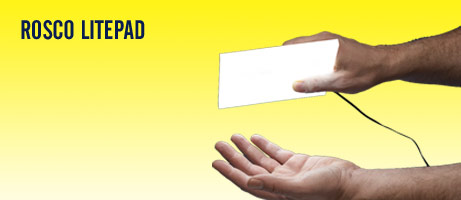
“LitePad is Rosco’s step into the quickly growing world of LED lighting,” says Mike Wagner, Rosco Product Manager. “Rosco has recognized that LED technology is a great tool, but to use them in the film and TV industry they need to be applied in a creative way. Rosco was able to come up with a way to use LEDs that produce a soft, even beam of homogenous light.”
The key element to the Rosco LitePad is a clear acrylic panel with a tightly woven laser etch grid pattern. LEDs are embedded into the edges of the acrylic panel and aimed into the etched grid. The grid captures the light, much like fiber optics, and refracts it out the front of the panel with the assistance of a white reflective surface behind the grid. The result is a soft glow of diffused white light.
The LitePad produces 7000 degrees Kelvin color temperature and is powered by a 12-volt transformer. LitePad is 1/3-inch thick, making it easy to mount or place almost anywhere. The LEDs have a rated lamp life of 70,000 hours and an operating temperature of -22ºF to 185ºF. Rosco offers six standard sizes – 3”x3”, 3”x6”, 3”x12”, 6”x6”. 6”x12”, and 12”x12”. The 12x12 LitePad producers 35 foot-candles at 24” away from the source.
LitePads can provide fill light or illuminate an entire interior car scene, give three point lighting for an interview, and has been used as a small eye light above the camera. The trim thickness allows it to be hidden on a computer or laptop monitor. LitePads also only need 12 volts to function.
Future plans are in the works for LitePad, including a 3200º Kelvin version and both a manual and DMX controlled dimmer box. LitePad is dimmable but a special dimmer is needed to change the intensity of the LEDs.
www.rosco.com |
| |
|
 |
| |
|
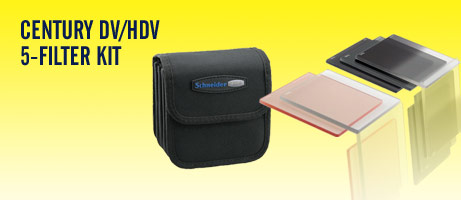
?“Century specifically selected the five most useful filters and designed them for HDV shooters,” explains Bob Zupka, Product Manager MPTV Filter Group for Century/Schneider. “These filters should take care of 95 percent of the situations to allow maximum use of HD cameras.
“We looked at the database of most commonly sold and used filters. Our filters have been designed to give control in the camera of things that can’t be done in post—exposure control, polarization, softening of the video image. You can’t remove a windshield reflection in post. You can’t fix blown out windows in post. Just like the tripod or matte box or lighting kit—our new filters give the DV/HDV shooter the most versatility possible.”
To best handle exposure, Century offers two ND filters. The Neutral Density .6 Solid filter reduces transmission by 75 percent, controlling exposure depth-of-field under various lighting conditions without affecting color or contrast. Century’s Neutral Density l6 Soft Edge Graduated filter employs a surface that is 50 percent clear and 50 percent with a neutral density of 0.6 (two stops), to balance exposure with a scene—for example, the exposure of sky and earth in a landscape, which avoids overexposed blank white skies.
The Century Polarizer reduces glare and unwanted reflections, saturates colors, deepens blue skies, improves contrast, and penetrates haze.
For subtle enhancement of a scene, the Black Frost 1/2 Diffusion filter can be used to flare highlights, mute colors, and tone down contrast, without degrading image quality or black saturation.
Century’s Skintone Enhancer Warming filter adds warmth to skin tones and accentuates foliage and architecture while reducing excessive blue in outdoor open shade. This works for romantic close-ups. It can be effectively combined with Century softening filters.
The filters are offered in 4”x4” sized filters, to fit in any standard mattebox filter holder.
www.schneideroptics.com |
| |
|
 |
| |
|
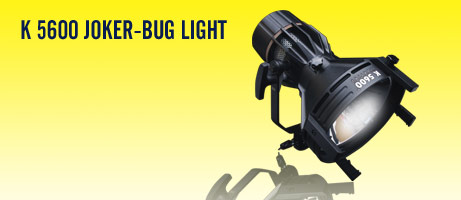
“We make lighting tools for the reality of today and tomorrow’s production environment,” explains K 5600’s founder and owner Gilles Galerne. “The future is not difficult to predict: More productions, faster set-ups with less lights and less people… The mission is clear—lights that are smaller, lighter, more compact, more versatile, fast to set up/break down and controllable to maintain a certain quality of light.”
This is how the Joker-Bug Kits were designed. “As an HMI fixture, it benefits from the highest efficiency in terms of lumens per Watt from the lamp, as well as full daylight spectrum,” he explains. “As a PAR, it benefits from very efficient lumen output with optical beam patterns from, as narrow as, 5 degrees (for distance reaching or building-facades ‘washing’) to, as wide as, 60 degrees for closer shots.
“With its removable Beamer optical block, the Joker-Bug in the Bug mode can be inserted in a Source Four pattern projector to create vivid color effects as well as highly controlled beam or gobo patterns. The Bug mode is also the most efficient way to create a large softlight with the help of a Lightbank.”
According to Galerne, the possibilities are endless. The open configuration mixed with the compact size of the Bug-Light can be worked as practical in many sets. Well-adapted accessories such as the Softube widen the range of action of the units, turning a normally spotty PAR into a long linear soft source.
Power issues were also addressed and the Joker-Bugs are easily used on AC (110-240V) as well as DC (30V).
www.k5600.com |
| |
|
 |
| |
|
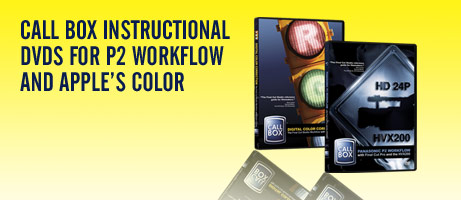
For those who recently dropped ten grand on a brand new Panasonic HVX200 camcorder and Apple’s Final Cut Studio 2 and would like some great advice, Call Box comes to your aid. Call Box Live, an interactive training company for digital media producers, introduces their latest training DVDs, “Panasonic P2 Workflow with Final Cut Pro and the HVX200” and “Digital Color Correction – The Final Cut Studio Workflow with Apple’s Color.”
The DVDs are created and hosted by Apple Certified Pro instructor Noah Kadner, who is a filmmaker and an expert on Final Cut Pro. “The P2 data-centric workflow is a whole new world for producers used to shooting tape,” says Kadner. “Our DVD goes step-by-step from pre-production planning through output to DVD. We want to empower professionals so they can spend more time bringing their stories to life.” For the P2 Workflow DVD, topics covered include Field Workflow, 720p and 1080i, P2 storage, output for 24p DVD, native MXF editing with Raylight and more.
The Digital Color Correction disc, which is co-hosted by professional colorist Stuart Ferreyra, is broken down into learning modules with interactive demonstrations and real-world examples. Topics include Workflow with Final Cut Pro, Equipment shopping lists, primary and secondary correction, high definition formats, render management, motion tracking, and more. Both DVDs are targeted more towards independent filmmakers who have some knowledge on production and postproduction workflows rather than hobbyists looking to shoot their children’s birthday party.
The DVDs are priced at $75 each and can be purchased directly from the company at:
www.callboxlive.com |
| |
|
|
|
|
|
|
|
|
|