The first film-out test, using an unnamed laboratory, was, as Pierce-Roberts put it, “a disaster.” The company contacted Technicolor in Los Angeles to redo the digital transfer so that he could truly see what the cameras would give them. “In the meantime, I was fortunate enough to be allowed to visit David Fincher and Harris Savides (ASC) on the set of Zodiac,” he says. “When I told Harris what we were planning to take the Vipers to shoot in the desert, he told me, ‘Don’t do it. Go home immediately.’”
The time Pierce-Roberts spent with director David Fincher and discussions with director Michael Mann and his producers was well spent. “The way people were prepared to share their experience of HD was very gratifying,” he says. “I’m extremely grateful to both David and Michael for their time.”
The new film-out lead Pierce-Roberts to the decision to use Vipers throughout the production, and record in the Film Stream mode, “where you merely record data and do all the grading later, as opposed to video-streaming, where you can do a polished grade on set,” he explains. “Given our very sort shooting schedule (36-some days), we didn’t want to spend time discussing these issues on set and I’m very pleased we went this route.”
“When we viewed the tests against the 35mm film footage, the choice was made to go with the Viper for the entire feature,” adds Green.
"THE [VIPER] CAMERA ITSELF IS AMAZING AS FAR AS WHAT IT CAPTURES... THE WAY THE CAMERA AND LENSES HOLD DETAILS IN THE BLACKS AND HIGHLIGHTS AMAZED ME. THE CAMERA SAW THINGS THAT WERE ALMOST INVISIBLE TO THE EYE. I HAD TO REALLY EMPHASIZE MY HABIT OF VISUALLY SWEEPING A SCENE FOR REFLECTIONS, BOOM SHADOWS, TAPE MARKS, ANYTHING THAT MIGHT SHOW, BECAUSE THIS CAMERA SEES EVERYTHING."
OPERATOR
GEOFF SHOTZ |
“Unfortunately, when I received that information, it was Thursday afternoon at 3:00 p.m. We had prepped the 900s all week to take to Morocco and we were supposed to ship on Friday. Plus 8 stayed open for us Saturday and Sunday in order to make a new deadline of Sunday at 1:00 p.m. We worked 12-13 hour days to organize our package that would have to be right, as shipping to Morocco is never fast! A mistake could have cost us delays of three days minimum.
“The other important issue was the fact that this was being shot in the widescreen format, which I believe for the Viper is considered 2.37:1. So, the lenses had to be good from frameline-to-frameline, as feature films shot in widescreen rarely center frame actors. And, Tony is an artist and loves to paint the picture edge-to-edge. The hunt was on for lenses that would perform this task. The only lenses that we found to be able to handle this challenge were the Zeiss DigiPrimes and DigiZooms (6mm-24mm), which in 35mm terms would equate to 15mm-60mm. Tony preferred that we re-label the lenses in terms that feature filmmakers would be familiar with. We also used a longer Fujinon Zoom equivalent to a 25mm-250mm when necessary.”
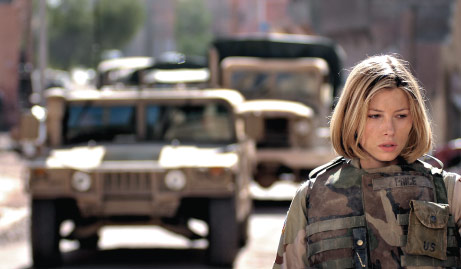
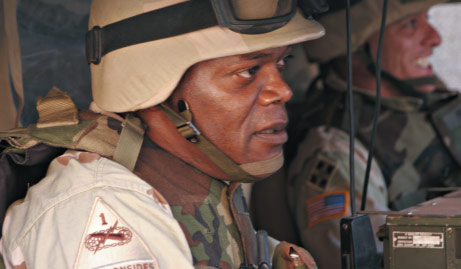
One of the things that Pierce-Roberts learned from people who “knew” the format was “that I should expose as though I were shooting reversal film stock and therefore expose for the highlights. We did this on our film test,” he explains. “People would come up and say, ‘Look at the sky, its burning out.’ Having seen my tests, I feel one should take this advice with a pinch of salt, since we did have several black actors. I didn’t want their flesh tones to be too compressed. Anyway, even if I had been shooting film in the desert situation, I would have wanted the sky to burn out a little to convey the sense of heat. I wanted to see facial expression under the helmets. So, I read and adjusted the waveform monitors accordingly.
image is. Then you wander over to the D.I.T. station and look at that same image run through the LUTher box with a basic look assigned to it and you are stunned. The way the camera and lenses hold details in the blacks and highlights amazed me. The camera saw things that were almost invisible to the eye. I had to really emphasize my habit of visually sweeping a scene for reflections, boom shadows, tape marks, anything that might show, because this camera sees everything.
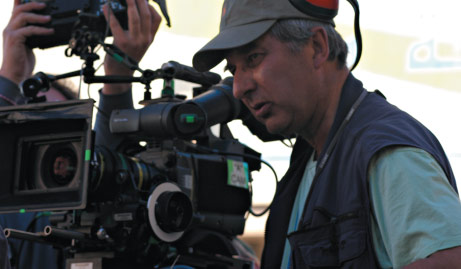
“But that brings me to the biggest problem for an operator,” Shotz adds. “The viewfinder. It is pretty much useless. You can’t see any details or potential problems through it. As an operator, it was a constant battle to just see my frames with this finder system. Having shot features and television on the Sony F900, 950 and the Genesis, the Viper is way far my least favorite viewing system.” Despite the challenges of the Viper system, Shotz marks shooting Home of the Brave as a remarkable situation. “Because of Tony Pierce-Roberts,” he says. “Peter Green introduced us and Tony hired me on his recommendation. I found him to be the DP all others will have to live up to from here on. He is very much old school hands-on and nothing escapes his attention. But, no matter how good or bad the situation, he never lost his perfect English gentleman’s demeanor.” |