|
|
 |
|
 |
|
|
|
|
|
|

|
|
JUNE CONTENT:
|
|
|
|
MR. BROOKS, DP John Lindley, ASC
By David Heuring
KNOCKED UP, DP Eric Edwards
By Elina Shatkin
GRACIE, DP Chris Manley
By David Geffner
THE RICHES, DP Michael Negrin, ASC
By Pauline Rogers
PRESIDENT'S LETTER
by Steven Poster, ASC
CREW VIEW, First Assistant Alan Gitlin
By Bonnie Goldberg
|
SIN CITY, NAB 2007 Showcase New Trends, Technology and Production Tools
By Neil Matsumoto
PARTNERS ON THE SET, 3:10 To Yuma DP Phedon Papamichael, ASC and operator Dave Luckenbach, SOC
By Pauline Rogers |
|
|
|
|
|
|
 |
|
JOHN LINDLEY, ASC FOLLOWS THE PATH OF A SERIAL KILLER FOR MR. BROOKS
By Pauline Rogers
Photos by Jonathan Wenk |
| |
 |
| |
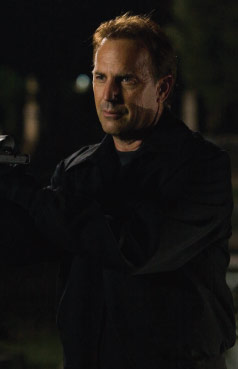
Earl Brooks is a family man, philanthropist and Portland Chamber of Commerce Man of the Year. But behind the perfect façade lurks a serial killer who has never been suspected, much less caught. An opportunistic amateur photographer (Dane Cook) happens to witness what was to be his final crime, and an unorthodox but persistent detective begins a battle of wits with Brooks. That is the premise for Mr. Brooks, which features Kevin Costner, William Hurt and Demi Moore in leading roles.
The script was co-written by Raynold Gideon and director Bruce Evans, whose previous collaborations include such memorable films as Starman and Stand By Me. The cinematographer was John Lindley, ASC, whose eclectic resume includes The Serpent and the Rainbow, The Sum of All Fears, You’ve Got Mail, Father of the Bride, Sleeping With the Enemy, Bewitched, and Pleasantville. Lindley estimates that he had around a month in preproduction with Gideon and Evans.
“They’re writers, but they’re not just interested in the words,” he says. “They have good taste and are knowledgeable about art, and they had an enthusiastic interest in the looks we created to help tell the story.”
Although the story takes place in Portland, Oregon, the movie was filmed in Shreveport, Louisiana. “It’s one of the ironies of contemporary times,” says Lindley. “Changes in equipment freed filmmakers from the studios. Suddenly you could go to a location and be inspired by things you hadn’t seen before, photograph things that maybe the audience had never seen, and draw a location into a movie the way you would introduce another character. But today, the decision is often made because of financial reasons. You’re much more likely to be playing defense than offense with a location. We are supposed to be in Portland, so we’d better not see any Spanish moss.”
Lindley had about 45 days of principal photography scheduled. “Movies, whatever their size and resources, have pretty big appetites, and this project was no exception,” he says. “But every movie should reach further than seems possible on paper. That forces an economy of thinking and coverage that I think is healthy.”
The filmmakers considered a widescreen Super 35 format but in the end opted to compose in the Academy aperture 1.85:1 frame. “We talked about how the wider frame would offer more negative space, which in a suspense film can keep the audience wondering,” says Lindley. “But we decided to take that same approach within the standard 1.85 frame. There’s not quite as much room, but in the end it was fine to do it that way.”
One key to selling Shreveport as Portland was the talented production designer Jeffrey Beecroft. “Jeffrey is a good photographer in his own right, with a keen eye for locations,” he says. “We were able to shoot in interesting places that didn’t look like Louisiana.”
|

|
|
"MOVIES, WHATEVER THEIR SIZE AND RESOURCES, HAVE PRETTY BIG APPETITES, AND THIS PROJECT WAS NO EXCEPTION. BUT EVERY MOVIE SHOULD REACH FURTHER THAN SEEMS POSSIBLE ON PAPER. THAT FORCES AN ECONOMY OF THINKING AND COVERAGE THAT I THINK IS HEALTHY."
DP JOHN LINDLEY, ASC |
|
|
The filmmakers enhanced the illusion with liberal use of water on streets and windows to communicate the dampness of the Pacific Northwest. Also on their side was the fact that most exteriors took place at night.
All interiors were filmed at real locations except for several important scenes between Costner and Hurt’s characters that take place in a studio adjacent to Brooks’ house. Those scenes were filmed in two days on a two-story set constructed for that purpose.
The story naturally divides between Mr. Brooks’ normal, “Man of the Year” life and his serial killer underside. Lindley amplified the dichotomy by shooting the first world with a warmer look, and the violent elements of the story with a more raw, contrast feeling with higher key light and less fill.
Lindley shot with an ARRI 535 as the main camera and a Moviecam camera that split time between B-camera and the Steadicam rig. A-camera operator and Steadicam duties were handled by Lawrence Karman, and the B-camera operator was Ted Chu. The camera crew also included Gregory Irwin, Jerry Patton, Peter N. Green, Milan Janicin, Jessica Lee, Peter D. Roome, and camera production assistant Amanda Bruce.
“We did a fair amount of Steadicam work,” says Lindley. “We used it in the obvious situations, like long walks in the streets, but we also did some in the smaller locations where we wanted to go through doorways and down hallways. I find that in a suspense film, a very long take can build tension because people sense that something’s about to happen. The Steadicam was helpful in those situations as well.” Focal lengths tended to be wider. “I like the idea in this kind of movie of getting closer to people with a wider lens, and creating a little bit more depth of field,” says Lindley. “I wasn’t too concerned with whether the photography was terribly flattering to the actors. I felt comfortable choosing the lens and lighting in ways I felt were right, and not trying to create too much of a ‘high |
|
 |
|
fashion’ look. There’s a fair amount of handheld work, which lends itself to wider angle lenses.”
Lindley recorded images on KODAK VISION2 500T 5218 film in indoor and nighttime situations, and KODAK VISION2 100T 5212 stock in day exteriors. “Those stocks give you a lot of freedom,” he says. “They work well with digital intermediate (DI) timing. I was comfortable knowing I could play around with the images in DI.”
He used a range of lighting instruments, including Kino Flos and small Chimeras that worked well in the tight locations. “These places didn’t lend themselves to big lights,” he says. “It’s kind of nice to work that way. I collaborated with a gaffer named John Vecchio. I’ve worked with him for a long time. He made a great contribution. He’s a good guy, with a good eye, and he’s very upbeat and happy to be on the set. That helps to keep your mind clear, so you don’t tunnel into the stress of it all. The best thing someone can do for you is to release some of the pressure so you can think clearly. He’s a tremendous partner in that regard.”
For two crucial sequences, Lindley used light to manipulate the audience, walking a fine line between reality and nightmare. “There’s a sequence that you think is real that turns out to be a nightmare,” he says. “I don’t want to give away too much, but the action happens twice. Once it happens for real, and the next time it happens it’s a nightmare. It was a fun sequence to do. Even in the first time it appears, it was important to make it look like the rest of the movie, but to include some aberration so that later, the second time it appears and turns out to be a nightmare, there is some sort of telltale sign that it wasn’t totally realistic. I introduced some deeply saturated blue gels that weren’t used in the rest of the movie. They were sort of theatrical and a little hallucinogenic, and a little less representational than the colors I would have used in that scene had it not also turned into a nightmare. I enjoyed doing that sequence a lot.”
Because of his experience on Pleasantville, one of the earliest films to undergo a digital intermediate, Lindley brings a unique perspective to the DI suite. “Even if you know there will be a DI, you don’t necessarily know for sure that you’re going to be there to do it,” he says. “It’s not as simple as being sloppy on the set, knowing you can clean your mess up later. I don’t leave a lot of stuff for the DI if I can help it, and that was true on this movie as well.
“It’s a funny thing,” he continues. “At the time I shot Pleasantville, DI was considered by some to be sort of cheating. ‘You did all this stuff to the image after the fact, so what good are you?’ This year, every film nominated for the cinematography Oscar except one went through a DI. It’s pretty standard and nobody thinks twice about it, and I’m happy about that.”
Mr. Brooks was scanned at 4K resolution at Pacific Title in Hollywood. “4K scans are always better,” says Lindley. “I’ve been around since the genesis of the whole thing, and I remember when 2K was going to be the standard. Even at the very beginning, there were people saying that it made no sense. It’s still evolving today. I remember one-inch tape and two-inch tape. It’s scary for people to make huge investments in something that isn’t going to be around forever.”
Lindley worked for about nine days with digital intermediate colorist Maxine Gervais. “She is very thorough and has a good eye,” he says. “She is a good listener, which is important.”
Lindley had roughly 1,000 feet of footage filmed out over the course of the DI to be sure his intentions would be accurately represented in the final product. “I gradually sucked some of the color out of Brooks’ dark, violent world as time went on,” he says. “In a way, he becomes sort of bloodless over the course of the film, at least in his alternate life.”
The DI was also used to fine tune color and contrast in other sequences. “There are a fair amount of scenes with Kevin driving somewhere at night,” Lindley says. “I tried to use the DI to make all those scenes second cousins to each other in terms of hues of blue and green. At the same time I tried to make them all slightly different. The DI afforded me the opportunity to do that. Instead of changing minute quantities of gel on lights while we were shooting, I could do it later, with greater control. I’m pleased with the results of that work.”
Lindley’s advice to cinematographers working in digital intermediate for the first time is to see shots in context. “I’ve had a lot of experience with DIs now,” he says. “You look at the scene, you look at the shot, and then you stop and work on that frame. And you can really work forever on a still frame. Then, when you look at it in the context of the shot, often you realize that you overworked it. One of the things that experience teaches you is to run that shot as often as possible while doing corrections—and to see the shot before and after. It can drive a colorist crazy, because sometimes they’re used to the other approach. But I find it’s good not to have your foot on the accelerator the entire time.
“You have to know where you are in the movie,” he continues. “If you have a trajectory in mind in terms of color or contrast or both, you want to constantly remember that. It’s like having a script, but without words. You have to remember where you are in the story. I guess that’s true for every discipline. Dancers and musicians do it. Anybody who sculpts something out of a block of marble must know where they are in the context of the whole piece.”
Lindley sees the digital intermediate as an extension of the artist. “I don’t think it exists on its own,” he says. “It’s just another tool. Some people use it well and some people don’t. I see movies that don’t look good because they used it too much. Then I see movies where it’s used a lot for manipulation and I think it looks great. It just depends whose hand it’s in whether it’s a tool for good or a weapon. I don’t think it has a personality. I think it has the personalities of the people who use it.” |
| |
|
|
|
|
|
|
|
|
|