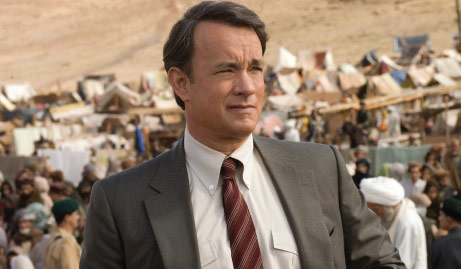
The December issue of ICG Magazine features an interview with cinematographer Stephen Goldblatt, ASC, BSC discussing the production of Charlie Wilson’s War. The film is his third collaboration with director Mike Nichols, following in the wake of the HBO miniseries Angels in America and the feature film Closer.
Charlie Wilson’s War is a filmic interpretation of a book written by former 60 Minutes reporter/producer George Crile about the role that Charlie Wilson, a congressman from Texas, played in defeating the Russian army after it invaded Afghanistan and brutalized the civilian population during the 1980s.
The film takes the audience on a journey behind the scenes with Wilson while he visits refugee camps in Pakistan that are filled with thousands of survivors of the Russian assault, and through the back channels of government while he orchestrates getting the CIA secretly involved in arming and supporting the rebels who fought the invaders.
Tom Hanks portrays Wilson, with Julia Roberts, Amy Adams and Philip Seymour Hoffman cast in other important roles. Goldblatt and Nichols made an aesthetic decision to compose the film in Super 1.85:1 format. Goldblatt put finishing touches on the look during digital intermediate (DI) timing with colorist Steve Scott at EFILM in Los Angeles.
The December issue of ICG magazine went to press before Goldblatt timed the DI. The following is an extension of that article. It is from a conversation between Goldblatt and Scott that took place during an interactive DI timing session.
Scott projects a scene on a cinema-sized screen. Goldblatt asks him to make the black level “a bit” denser. Before you can blink the tone is slightly darker.

|
|
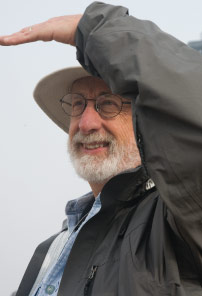 |
Stephen Goldblatt, ASC, BSC |
|
GOLDBLATT: Okay, I think that looks right. What’s next?
SCOTT: Look what happens in this next shot when you pull the camera back and get a wider angle of coverage. It’s really crisp, and you can’t tell that building is a visual effect composited into the scene. It looks seamless to me. What do you think?
GOLDBLATT: Can we make the building a little bluer?
SCOTT: How does this look to you?
GOLDBLATT: That looks right. Let’s take a look at the next scene.
QUESTION: This is obviously a dialogue scene. What are you looking for?
GOLDBLATT: This shot is all about faces and eyes. The skin tones and the light in their eyes look right to me. Let’s move on to the next shot.
QUESTION: What resolution are you working at?
GOLDBLATT: They scanned the negative at 4K resolution because we get more colors and other details off the film that way. We are timing the DI at 1K resolution, because it’s faster, but Steve applies the changes we make to the final 2K file.
QUESTION: Does knowing you are going to be doing a DI affect how you shoot?
GOLDBLATT: No. The idea is to get it as right as you possibly can when you shoot, but nobody is infallible, so it’s a nice feeling knowing you can fine-tune the look. There aren’t a lot of surprises. We had film dailies, so we were all on the same page.
SCOTT: I’ve worked with Stephen on a couple of earlier films (Angels in America and the feature film Rent). That helps, because I have a sense of his taste. I anticipated where he would want to use Windows to isolate and manipulate elements of shots. Maybe something in the background was too light or dark, or a color wasn’t quite right. My goal was to anticipate what he wanted to achieve, and set up this screening so he could get a fresh look at the film and make any changes as quickly as possible.
GOLDBLATT: There are also visual effects shots of things that were impossible or impractical to shoot that we have to integrate seamlessly.
QUESTION: Give us an example of putting finishing touches on a shot in DI.
GOLDBLATT: The opening shot is in a Jacuzzi in a fancy suite at a Las Vegas hotel. Mike (Nichols) and I agreed that we wanted it to be a somewhat-abstract look. I had an idea for starting the shot with the camera underwater in the Jacuzzi and coming up to the surface when the first character speaks. Then, the camera pulls back and reveals Tom Hanks and the background behind him, which tells the audience that he is in Las Vegas.
QUESTION: What changes did you make while timing that shot?
GOLDBLATT: I asked Steve to show me what it looked like if the water was a little bluer while the camera was in the Jacuzzi. I also asked him to make the background behind Tom (Hanks) a little more saturated when the camera pulled back.
QUESTION: Are those looks that you pre-visualized while you were shooting?
GOLDBLATT: I had the whole picture of the movie in my head, but I also know that when I saw the film projected in the DI suite, we could play with it and make it better. Before DI became a practical option, you would live with what you got when the camera was underwater. You didn’t think about it twice. But now, when you combine the astonishing ability that film gives you to record details with the flexibility you have in DI, it is becoming second nature to do things like making the water a little bluer. … I’ll give you another example. There are shots where I felt that colors in Las Vegas backgrounds weren’t vibrant enough when we saw film dailies. It was a simple fix.
QUESTION: We are now looking at a shot inside a moving car with Charlie Wilson and a blonde woman. Tell us about this shot and what you are doing in DI.
GOLDBLATT: We shot this scene on stage with bluescreen. It is supposed to be on the way to the Las Vegas airport during the early 1980s. We had the camera on a mini Technocrane and the windshield removed so we could kind of float it through the inside of the car. I’ve asked Steve to make the blonde hair a little lighter and Tom’s tan a bit darker.
QUESTION: Steve (Scott), how do you know what a cinematographer means when they say bring that blonde hair down ‘a little’ and his tan up ‘a bit?’
SCOTT: Part of my job is to learn what they mean when they say a little or a bit. I’ll make an adjustment and ask if that’s okay. After a while, I can anticipate what they want and more easily interpret what they say. I feel privileged to work with incredibly talented people. I’m motivated to do anything I can to protect their vision.
QUESTION: That sounds like a big responsibility.
SCOTT: Think about it. A cinematographer spends months prepping for and shooting a movie. It’s an incredible responsibility, doing what I can to protect and help them enhance their visions. It keeps me up at night thinking and worrying about doing it right for the cinematographer.
QUESTION: We are sure that you have more insights to offer.
SCOTT: One of the interesting things is that I am basically seeing silent movies in the DI suite. You learn to watch expressions on faces, the movements of hands and body language to see what emotions they are conveying. All of those things affect how cinematographers time DIs to reinforce a sense of time, place and emotions.
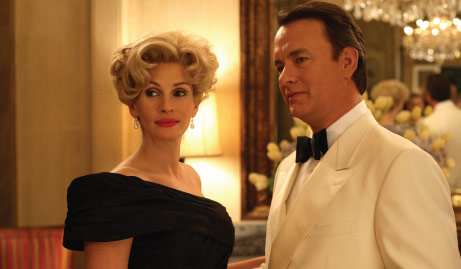
GOLDBLATT: The resolution of film gives you a lot of freedom to manipulate images in DI. We had a scene where a last-minute decision was made to change a costume that Tom (Hanks) was wearing from a traditional black dinner jacket to a white silk dinner jacket. Julia (Roberts) was wearing a black dress in that scene. We had a very, almost impossibly, broad range of colors and textures in those shots. We shot this scene with them walking up a staircase with a narrow landing. I knew that we would have the flexibility to adjust the contrast of the jacket in the DI. I could say, ‘Steve, try this and let me see what it looks like.’
SCOTT: Stephen was a professional still photographer before he was a cinematographer. He showed me still pictures that he took on sets and manipulated in PhotoShop, so I could see what he had in mind while I was preparing the digital master file for him to time. Stephen understands the basic concepts of how DI works. I was basically his conduit for using that technology to add final touches to the look. |