|
|
 |
|
 |
|
|
|
|
|
|
|
|
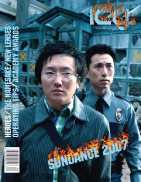
APRIL CONTENT:
|
|
|
|
HEROES, DPs John Aronson and Nate Goodman have great powers
By Pauline Rogers
PRESIDENT'S LETTER
by Steven Poster, ASC.
THE NAMESAKE, DP Fred Elmes, ASC shoots a culture clash
By Jon Silberg
CREW VIEW, Operator Joe "Jody" Williams
By Bonnie Goldberg
NEW LENSES,
By Pauline Rogers |
OPERATING TIPS
By Bill Hines, SOC and David Frederick, SOC
ICG IN THE SPOTLIGHT, 2007 Publicists Awards
By Bonnie Goldberg
ACADEMY AWARDS NOMINATIONS FOR
CINEMATOGRAPHY
By Bob Fisher
2007 SUNDANCE FILM FESTIVAL
By Neil Matsumoto, David Geffner and Elina Shatkin |
|
|
|
|
|
|
 |
|
JOHN ARONSON AND NATE GOODMAN HELP SAVE THE WORLD FOR HEROES
By Pauline Rogers |
|
 |
|
While watching movies like The Incredibles, writer/producer Tim Kring got an idea. What if very ordinary people woke up and discovered that they have extraordinary abilities? Soon, the little seed grew into one of the hottest television series to hit the airwaves—Heroes.
“I met Tim through working on Crossing Jordan, another show he created,” says cinematographer John Aronson. “I was doing Without A Trace and, although they asked me to do the pilot for the potential NBC series Heroes, I didn’t want to leave the show. However, when pilot cinematographer Adam Kane decided that he didn’t want to do the series, I became interested.”
Part of what interested Aronson was that the look of the Heroes series was going to be different. “We talked about a no rules look and were asked to think out of the box whenever possible” he explains. “If we could create a master that worked well for telling a story they would use it.”
What intrigued him even more was that comic book and graphic novel author Jeph Loeb was brought in as one of the writers. “This really showed me that the idea was to emulate a comic book as much as we could,” Aronson continues.
“Tim didn’t want it to be X-Men. No tights or black leather suits,” adds Nate Goodman, who operated on the pilot and who is now rotating DP with Aronson. “The series essentially combines the graphic novel look suggested by Jeph’s and his partner’s (award-winning graphic illustrator and painter Tim Sale) style that emphasizes story with a lot of detail and shadows. The pilot read like a movie, and the idea is to keep that style and lend a feature look to the images.”
When Aronson and team began to approach the series, one very different element began to stand out. This is a story about individual characters. There is the genetics professor in India who, led by his father’s disappearance, tries to uncover a secret theory that there are people with super powers living among us. There is the young dreamer who tries to convince his politician brother that he can fly. A cheerleader who learns she is totally indestructible. A Las Vegas stripper, whose mirror image has a secret. There is the fugitive who baffles authorities unable to contain him. A gifted artist whose drug addiction is destroying his life but leads him to painting the future. A down on his luck L.A. beat cop who can hear people’s thoughts. And a young man in Japan who has developed a way to stop time. With fragments like these, there would be few permanent sets. They needed a different way to accentuate each story thread, each character’s struggle to come to terms with and use his or her abilities. “We didn’t want to do a visual style for each character but thought that what might be interesting is to distinguish between the different locations with a distinct visual approach,” Aronson explains. “This way, as we cut from story to story, the audience will quickly know just where they are.” |
| |
 |
| |
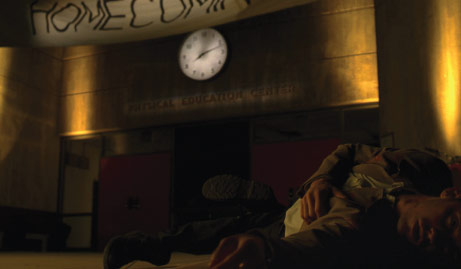
When the story cuts to New York, the visual is cool with black and white design elements. Tokyo is an uncorrected fluorescent green/blue. Las Vegas is done with bleach bypass and blown out whites. Los Angeles is saturated, with a true clean look. Texas is shot with Tiffen Antique Suede and India with the same Antique Suede, but much heavier. “In the first five episodes, we used filters and over-exposed the shots,” Aronson explains. “However, as we got into the series and locked down the looks, we decided to shoot normally and let the people at Technicolor make the visual differences.”
Aronson and team shoot the series with two cameras, Panavision’s XL and Gold, and Kodak 5218. “We do non-traditional shots with the two cameras,” adds Goodman, “but we often shoot the sequences as oners, letting the story play out with multiple characters, not cutting to close-ups right away. John is not interested in doing anything ‘standard’ and neither am I,” he continues. “We try to design sequences that dramatically cram a lot of narrative information within the frame, often using lenses in the 21 to 40mm range, having characters approach the lens retreat and give way to another character’s close-up, and low angles that center the characters in their environment and emphasizing their heroic potential.
“We also use the Century/Panavision Swing Shift lenses, both as a way of playing foreground/background focus and to bend the images to make them just a little bit off. This way of treating the blocking also lends to the graphic novel approach.
“We’re just fortunate that everyone from the network on down supports the look. I admire that NBC is committed to the 1:78 letterbox format which allows us more room in the frame to play.”
There is nothing standard about the way the stories are played out on this series. To ask both Aronson and Goodman to “pick a few iconic sequences” is almost impossible and there are no “elements” that repeat or typify the series. There are, however, sequences that challenged each person’s creative abilities and definitely get the juices flowing.
“We do a fair amount of work on stage,” says Aronson, “which is one of the biggest challenges because each set is literally designed for the episode. Only a few sets are standing so we seem to shoot one while pre-lighting two others. Our show is like a runaway train. We have six big stages at Sunset Gower, a budget that is more than reasonable but many constraints that are not normal to a television show.
“For example, because we want heroic low angle character shots, most sets have a solid ceiling. We have a house set built to duplicate an existing house so only a few walls fly duplicating shooting on a practical location. Few sets have floors that allow us to dolly directly on so miles of dance floor go down. One rooftop set is six feet in the air, dictating camera on a 50’ Technocrane, with 270 degrees of blue screen. We shot an Airstream type trailer where nothing is wilded, and a diner set that was built into the stage elephant door so sunshine had to be dealt with. We can’t just walk in and throw a switch.”
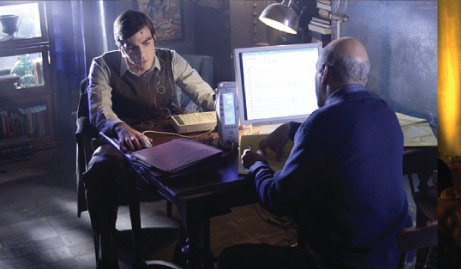
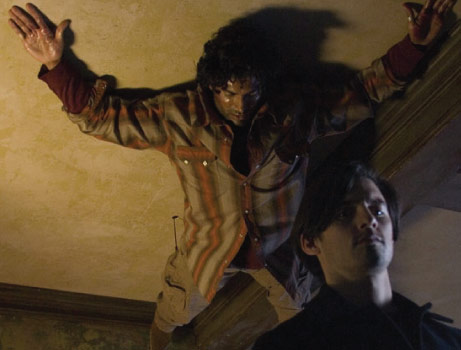
One of Aronson’s favorite sequences is a swing set for the evil character Sylar. “In the story, we discover the character’s origins, turning from a meek clock builder to a serial killer bent on becoming ‘special,’” Aronson explains. “Production designer Ruth Ammon designed a set that really lent itself to this idea of multiple planes of information. This clock shop looked classic, old, realistic and creepy all at the same time. “To light it, we designed Linestra lights into the set and then added only soft cool New York daylight in through a few windows. This allowed us to generally light the space in a naturally moody way but also to subtly and elegantly create a personal space for Sylar. The fact that the Linestras, a natural looking fixture, often created a soft under-light as Sylar looks up from his workspace at his first victim certainly didn’t hurt what we were going for in creating another element in the Heroes mythology.”
Another element that challenged Aronson’s creativity is the ongoing thread with Nikki and her alter ego Jessica. “Originally, the |
| |
|
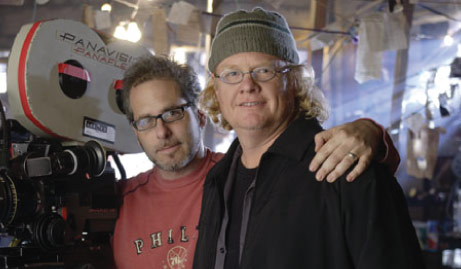 |
| Cinematographers Nate Goodman and John Aronson work together to help create the visuals for Heroes. |
|
| images were manifested through mirrors,” he explains. “We start with her talking to herself, that is, her sister, in the mirror. We used a byfold set of closet doors.
“We started the scene on the real Jessica and panned over to a green screen second mirror for the reflection—her reflection. We did three elements; all in one move then closed the door to complete the shot. The green screen element of Nikki fighting to get out behind glass was shot separately in the same space through a large piece of Plexiglas to give her something to press against, with the real background playing as the reflected background. When the elements were combined, our shot had Jessica talking to her reflection, Nikki, in the mirrored door, then closing the door and exiting, leaving the reflection Nikki alone in the room, trapped. It was a great effect that played without cuts.”
One of the things that Aronson loves is that the writers are always throwing something different their way. Sometimes capturing the story is about how the shot is dressed, or how it is lit. Other times, it is what technology they use. “In the story thread of our policeman who can hear other people’s thoughts, we are always looking for different ways to support that element,” Aronson says. “For one sequence we used the swing and tilt lenses to evoke the warping of his environment and the pain he experiences as a myriad of peoples’ thoughts barrage his mind.
“The shoot was in a convenience store,” he explains. “Our hero hears a guy thinking about robbing the store. To convey his uncontrollable feeling, we handheld the swing and tilts and messed with the focus back and forth as we swung around him.
“At the other extent of what we have to do is a scene in episode eight, with our radioactive man. When he gets angry, he radiates. In this episode, we used the camera and lens to keep the glass of water in his hand close to frame in focus and keep him in focus without having to resort to cuts.”
Aronson and team led by key assistant Greg Morris, Gaffer Derrick Kolus and key grip Chuck Crevier are constantly trying to keep things lively and still make the day’s pages. And make it look different. They are storytellers in their own right and are encouraged to contribute more than just pulling off the technical aspects of the show. “This show,” says Goodman, “needs that kind of crew to be able to hit the constant barrage of curve balls out of the park.”
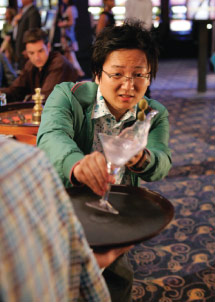
Aronson also recalls another element that he found interesting and challenging, this time involving the Japanese character, Hiro, who has learned to stop time. “This one involved a lot of high speed and green screen rigs,” he explains. “What we had to do is focus on the character and also stop time and follow the actual comic book of the future. He is,” Aronson explains, “a character in the book. We see him walking in Tokyo, and he sees a young woman hit by a truck. He has to save her.
“To do this, the comic book was drawn first and then we had to match our characters to the book frames. Background actors had multiple green rigs to hold them frozen in hard positions, jumping rope, running, etc. To make crisper images, and give us the feeling that we needed, we shot this at 96 frames and printed back to 24.”
“A truck hits a table full of toys and Hiro stops time,” Nate Goodman explains. “We had a 3D CG model of the toys in the air, so he can duck under things.
“We rigged the truck with a table stuck to the front of that truck with debris flying. Hiro runs through these CG objects, even knocks into them—they shift position in mid-air—and pushes the time-frozen girl out of the way. Safely to the side, Hiro then unfreezes time; the truck plows past them through the rest of the vendor tables and reveals the two of them safe to the great delight of Hiro’s compatriot, Ando.
“In another of these sequences, Hiro and Ando come upon a car wreck in the middle of the desert. Another of our heroes, DL, is coincidentally there as well and is in the midst of using his powers—fazing his body through solid objects—to pull a trapped woman from the burning wreckage. Hiro sees the leaking gas and runs forward freezing the impending explosion mid way. This way he can push DL and the woman to safety, though the comedic gag is that he finds them much more difficult to move than the little girl he had saved in an earlier episode.”
“We used five cameras running at high speeds to capture the explosion from different angles with Arriflex 435s running at 150fps with 11 degree shutters and a Photosonics at 300fps,” continues Goodman. “We needed to provide super sharp still frames for Stargate Digital to have the perfect moment to freeze the explosion without motion blur. We then shot the appropriate green screens for each camera and elements with Hiro and the other characters so we could show the time stoppage from different points of view.” Aronson is very adamant about the need for everyone to work together, to share the load, and to come up with creative solutions that work for each shot. And, he is very generous about sharing that load and the credit for achieving what gets done in the shooting schedule they have. “I have to say, Nate has often had some of the tougher scenes,” Aronson says. “We have a new rooftop set that goes from the floor to the perms and wall to wall on the sides of the building. It has been designed and lit with Spacelights inside the perms that are actually higher than the perms. We’ve created a silk at the bottom that can be pulled away, allowing us to bring a solid or a day-blue in and shoot up into it, which allows for about 270 degrees of blue screen. Nate did an incredible job with this sequence.” |
| |
 |
| |
“Again, Ruth Ammon went the extra mile for us on this sequence,” adds Goodman. “The set was built close to shoot time. She’s great at pre-figuring what we might run into, which helped us move into it quickly. Ultimately, the goal of the show is to transport audiences to the heroes around the globe so we do a lot of blue and green screen work. This rooftop set overlooks Manhattan and Central Park. We’ve also been to India and Tokyo this season without ever having to go through airport security.” Now we are doing virtual backlots, we shoot a car and actors on blue in our parking lot and Stargate puts them in parked in front of a New York landmark.
Goodman echoes Aronson’s sentiments about how different the show is. “What other episodic television show would dare shoot something in black? I don’t mean movie black or theatrical black, but real black,” says Goodman. “In episode twelve, we have a storyline that involves the Nikki character arguing with her Jessica alter ego while in solitary confinement.
“Tim Kring was adamant that we didn’t want to see her transitions from character to character, having her appear sporadically in a sliver of light scraping one wall. For a good part of the scene, she’d walk into total black. This is very unusual for network television where faces are king. So, we went to the producers and the ‘no rules’ theory really applied. We got to do graphic black.
“It’s great for the directors as well, which certainly helps us. Directorial show runners Alan Arkush and Greg Beeman are so infectiously enthusiastic about filmmaking. It must be great for them to be on a show where they can really spread their wings and push all of us to do better and more interesting work. One of our directors, on moving to another show, told me how difficult it was for him to get motivated to prep after being allowed to reach for something different on our show.”
The production often shoots in Downtown Los Angeles, which is a great place to shoot, dress and light for different locations. Sometimes it subs for Tokyo while other times New York. Each DP has had his share of interesting sequences in this ever-changing location.
“In episode eleven,” Goodman elaborates, “we had a prophetic dream sequence that involved 150 abandoned cars jamming the street and all the heroes joining together to witness one of them going nuclear and destroying Manhattan. Technocrane and Steadicam at 40fps through the cars and rising up as Manhattan is leveled. Sometimes it’s hard to believe we’re shooting a television show. As Greg Beeman, one of our show runners and the director of this cool sequence, says in his blog, ‘Heroes, it’s like a television show, only bigger.’ The 12 to 14 day episodes prove it. “It is a joy to be on a show where the entire crew is excited about the finished product,” says Aronson. “The Friday lunchtime screenings give us motivation for the next week’s craziness. The show has exploded and I am grateful for a crew that has stepped up to the plate. I am glad that Nate, my longtime operator and friend, has gotten the call for the new second DP position. I hope we have all brought quality work to a quality show. |
|
|
|
|
|
|
|
|