CLIP ART - BRUCE SPRINGSTEEN VIDEO
By David Heuring
PARTNERS ON THE SET
By Pauline Rogers TIPS & TOOLS
New Lighting Products
By Pauline Rogers LED LIGHTING
By Neil Matsumoto
EVERYTHING IS
ILLUMINATED
Lighting stories by cinematographers
By Pauline Rogers
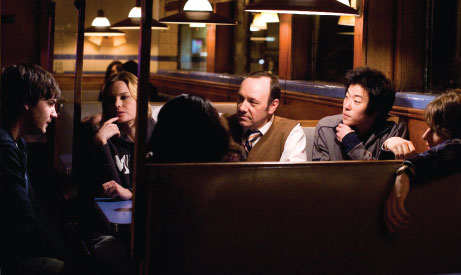
At first glance, the young protagonist of 21, Ben Campbell (Jim Sturgess), seems to have it all. He attends M.I.T. and has achieved a 4.0 grade point average but then he discovers his dream of attending Yale has become seemingly unattainable, owing to a tuition gap of $300,000. The boy’s gift for mathematics makes him an ideal recruit for Mickey Rosa (Kevin Spacey, who also produced), a university teacher with a scheme to strike it rich in Las Vegas. Ben and other bright M.I.T. students are put to work on a series of weekend card-counting schemes at various casinos, and for a time, are immensely successful, raking in millions of dollars. But nothing lasts forever, and soon enough, casino security forces begin to put two and two together about the team, while friction develops between Ben and Mickey.
Based loosely on author Ben Mezrich’s nonfiction book “Bringing Down the House: The Inside Story of Six M.I.T. Students Who Took Vegas for Millions,” the film takes certain liberties with the true story, which took place more than a decade ago, updating it and streamlining the number of players in the drama.
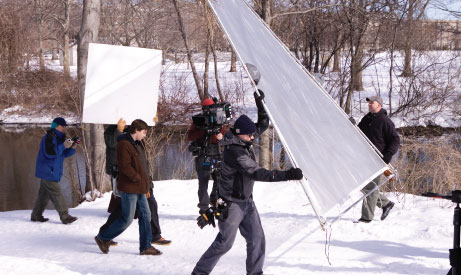
For cinematographer Russell Carpenter, ASC, 21 continued his exploration of smaller-scale storytelling. After shooting a 3D short and a pair of mega-budget features for James Cameron (one of which, Titanic, won him both ASC and Academy awards), plus the Charlie’s Angels films for director McG, Carpenter worked on a pair of comedies and more recently, the thriller Awake. “For me, this film was a kind of ‘Tale of Two Cities,’” he says. “We start in a cold grey place—Boston in winter—where I used very neutral light from natural sources. Then, with the Vegas segment, we’re all squiggly lines and energy, almost a Mardi Gras of colors you don’t see in the natural world. So even if the scale differed from past films, there were still a variety of looks that presented their own set of challenges.”
Prior to this film, director Robert Luketic had employed Carpenter as Director of Photography on Monster-in-Law. The director, who prides himself on being fiscally responsible, states, “We make a point of never going over [budget], and don’t have a lot of unusual happenings on my sets. That is in part because Russ and his gaffer [Len Levine] do so much homework that little is left to chance, and because we always go in with a plan.”
In this instance, the plan revolved around achieving a certain level of realism. After his string of successful comedies, Luketic is the first to admit that he’s “Not known for films depicting realistic worlds. They are usually quite heightened. But on 21, I wanted to capture an authentic natural feel in the photography, especially in terms of casino environments and the privileges that these M.I.T. students obtained in Vegas.”
Towards that end, director and cinematographer considered the notion of shooting digital rather than originating on film. After they viewed some impressive tests at Panavision, Carpenter traveled to Las Vegas to shoot tests with Panavision’s Genesis system. “The look of casinos in real life is a very specific one, with perhaps twenty-five different color temperatures, and I thought that an audience would quickly notice how extra lighting for a traditional shot-on-film approach would pump things up in a way that detracted
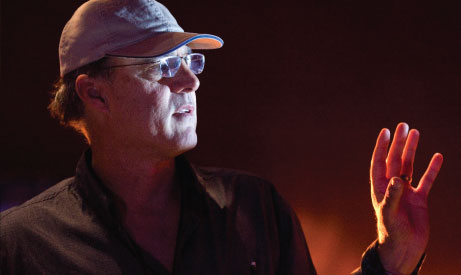
For DP Russell Carpenter, ASC, shooting 21 was like "A Tale of Two Cities" - using neutral and natural light for the Boston sequences and then a Mardi Gras of colors for Las Vegas.
from the reality of the place. My Genesis tests revealed that I could work at six to ten foot-candles, and sometimes fifteen foot-candles. That fit with my plan to shoot people walking through casinos on long lenses, nearly wide-open. Even with the best focus puller on film, you have the nail-biting and the sleepless night, waiting to see if you got the shot, but that wouldn’t be an issue with the Genesis.”
Luketic, like Carpenter, considered the Genesis to be uncharted territory. “If you’d asked me two years ago about shooting digital,” says Luketic, “I would have said, ‘Over my dead body.’ But the Sony/Panavision union is a good one. Panavision lenses are works of art, and cinematographers make a point of reserving particular sets months in advance. And there was something comforting about seeing those wonderful old lenses on the front of this great big digital box. It was gratifying for me as director to have Russell be able to show me an image that resembled the look and feel of what would be seeing in the cinema. My only complaint would relate to the size of the package, but even since we finished shooting, they’ve made great leaps in that area, so it is only going to get better.”
Since Panavision lenses employed on the Genesis render images that have focal characteristics and drop-off similar to film, Carpenter retained his usual film practices with respect to filtration. “I tend to light so that it isn’t necessary, even on women. When absolutely necessary, if someone had a really bad day, I might drop in a light Schneider Classic Soft. But knowing I’m going into a digital intermediate means I can do a local blur as needed, which is a more flexible tool.”
Carpenter was advised to capture all data in ‘raw’ mode. “While that makes for a very flat curve and unsnappy picture, you have to keep in mind that you’re capturing just for technical information,” he explains. “The advantage is you can lay in a meta-data look on top that says, ‘This is what I want it to look like on the monitor.’ I needed to build a look that mimicked 5218 stock, so DIT Doug DeGrazzio and I cooked up a very conservative 5218 curve that, on the monitor, wouldn’t see as deeply into the blacks as film. If I could see detail on the monitor, chances were good that it could be pulled up later in the DI. When we wanted to just barely see someone’s eyes, the monitor lets me know I got it long before we go out to film.”
The ‘seeing into darkness’ aspect was a significant one to Carpenter. “There is a myth that digital cameras can see infinitely deep into shadows,” he says, “but I found that different digital cameras see shadows in different ways. I saw deeper into the shadows with the Genesis than I would have with film, but there is a ‘floor’ at a certain point where you can’t pull anything out of the shadows—it is just murk. Whereas with a film shoot, you might be able to mine detail out of a shadow in the DI.”
SCHOOL DAYS
For visualizing the students’ lives in Massachusetts, Carpenter elected to keep things simple. “I didn’t show anything that wasn’t part of a typical working-class neighborhood, or that you wouldn’t find at M.I.T., which is just across the river from Boston. We never got permission to shoot on the campus—due to the card-counting subject matter, they weren’t too thrilled about us—so we staged scenes at Boston University, which really had a lot more of what I wanted anyway. As part of the contrast with Vegas, I liked the idea of confinement in the Boston locales, so I looked for and included frames within frames when possible to get a sense of enclosure.”
Massachusetts offered a tax incentive that mandated most of the film being shot in Boston. Consequently, a variety of locations were secured and converted to serve as the Vegas airport as well as various nightclubs. Production designer Missy Stewart built most Las Vegas interiors on stage in a freezing-cold Boston industrial warehouse, including several hotel suites with greenscreen outside the windows. “I’m not a big fan of playing scenes against walls,” Luketic admits. “We tend to oversize our sets. From a practical standpoint, that felt a little less cramped, which helps the crew. And in our hotel suites, there are chambers within chambers, which adds dimension.” The cinematographer concurs. “I love depth. I like to give the viewer the opportunity search out what is going on in the background, so the design worked for that.”
NEON NIGHTS
For production’s limited-duration Vegas shoot (something on the order of twelve or fourteen days), Carpenter relied primarily on existing fixtures within the casinos. “Fortunately, we also had the option to embellish as needed. The art department brought in hundreds of practicals. I could put them anywhere in the casino and not worry about concealing them, while cable was not a huge presence. There was a mix of Kino Flo VistaBeams and Barflys, plus various Source 4s [Tungsten Multi-Pars].” After scouting a number of casinos to see what each location offered, Carpenter created a zone system for shooting. “I didn’t want us to be wandering in the wilderness, so this way, everybody knew up front where we’d need to be for any given part of the story.”
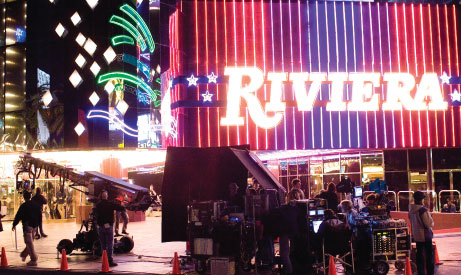
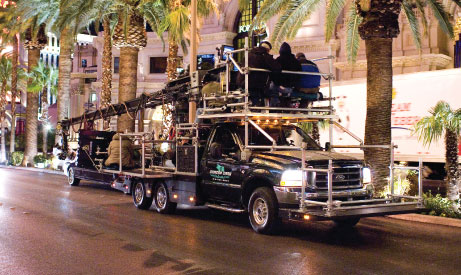
The Hard Rock, Planet Hollywood, Red Rock Resort and the Riviera were all featured during filming, which took place during normal business. “The plus was that we always had a full house, but all that traffic did slow things down at times. We often ran two cameras in Vegas, usually one wide and one close. Occasionally we laid track, but when we had the space, we used a Technocrane.
The director wanted to open the movie up at times so the audience could see the size of the casino, and the Technocrane was great for that.”
Casinos are often more mazelike than linear. “That kind of layout can be visually confusing,” says Carpenter, “so using Steadicam seemed to be the best way to explore that space. Will Arnot ran Steadicam for us, while David Diano was our principal operator. They were very important to me, and what worked really well on this show was that each of them has a very different aesthetic sense; they frame differently. I could use Will for certain shots that had a particular kind of energy, while David has this wonderful classic sense of balance in framing. In situations where you thought a second camera couldn’t be deployed, Will would fish around and find some angle that told a story point. So being able to tap into these gifts was a real asset on this show.”
Some card playing coverage was best accomplished apart from the main unit shoot. “We found it more prudent to shoot movement of the cards after the scenes had been cut,” explains Carpenter. “So editor Elliot Graham, having set the rhythm of the scene, knew exactly what he needed and could orchestrate many of those shots. We used the Fraser [periscope] lens to shoot the cards. I also tested the [P+S Technik] Skater Mini, which is a nifty tool. Anybody who has to shoot a card game—and you know, one of these comes up like clockwork every four years or so—could find it to be very useful.”
Director Luketic prefers to limit storyboarding to scenes involving complex choreography or visual effects. “I like to let the staging develop during rehearsal,” he says. “It’s an organic, systematic, friendly process that works for me, and the cinematographer’s contribution adds another layer to it.” With more shots in 21 than in the director’s first two features combined, there were a number of challenges in the staging. “We were shooting very specific perspectives all the time. Often, we’d be in the mind’s eye of our hero.”
To capture Ben’s thoughts while he plays the tables, Carpenter used the 11:1 Panavision lens with diopters. “That let me get in extremely tight on eyes and helped convey a sense that his mind was computer-like as he analyzed the play around him,” he says. “On most of the film, I lit from one side of the frame, then took light away from the faces on the other side so they would sculpt well. I
used Kino Flo VistaBeams, run through a layer of light grid and a layer of full grid, which subdued the light so much that it felt environmental, rather than being a modeling light from a movie. The trick is that it is modeled, but looks like it is part of the casino lighting.”
This approach managed to encompass both the cinematographer’s own tastes and the dictates of realism on the picture. “I’m trying to have my cake and eat it too,” reveals Carpenter. “I’m old school enough to want the actors to look good, and I do want to have sizzle to the frame where appropriate, something interesting and gorgeous to look at. But it still has to seem like its part of that environment, even if I’m pulling a total cheat to achieve that.”
On one occasion, a scene taking place within the Hard Rock, Carpenter elected to go for an unmotivated stylish effect. “I had to pull it out of the hat there,” he acknowledges. “All the principals were seated around a low coffee table, and I was struggling to find a way to make it look interesting. We weren’t shooting below the line of the table, so I made that below-frame area into a kind of light box. That provided a soft glow, which looked interesting enough that we didn’t have to justify where it came from. As a cinematographer, when you do something like this, you have to ask yourself, ‘Am I getting away with this, or will it seem stupid to the audience?’ And your experience informs that determination.”
Things turn nasty for certain team members when they are recognized and subsequently interrogated. “We had trouble finding that location, then came across an air-conditioning plant that looked ominous,” says Carpenter. “We added a few China lamp practicals to give an ominous look, just lightly grace-noting some of the human shapes in frame, but overall kept things very dark, which worked for the mood.”
When viewing an early cut, Carpenter found himself pleasantly surprised. “The film really flowed, and its energy was quite brisk, which earns a tip of the hat to Robert Luketic and Elliot Graham,” he says. “It ends with an action sequence—the kind of thing I thought I’d left behind—which was fun to get back to again, and it works well given the context of the film. Some of the wildest moving stuff takes place inside what’s supposed to be the kitchen area of Planet Hollywood, shot on Steadicam. We had an Alien Revolution extension, which is a long arm with a roll cage. The Genesis is very heavy and wouldn’t fit inside the cage, so we had to shoot using a film camera, letting it get within inches of utter disaster as we ran through. No matter how the arm on the Revolution is elevated, it keeps the camera level. So we could start with the stick down low, whisking along just inches off the carpet, then go up to a countertop, and move again to ceiling level all in one shot.”
Carpenter is not only happy with the movie, but with the visual feel of it as well. “It does have a filmic look. And I learned just how well the Genesis handles highlights, which was a pleasant surprise and will affect how I expose next time out. I have no doubt that as chips are perfected and capture devices get better, we’ll see digital approach film’s great ability to transition from light to shadow in a smooth and graceful way.”
And the manner in which that impacts photography and cinematography is something Russell Carpenter, ASC, knows quite a lot about. “Russell takes the most beautiful pictures of flowers from inside his garage,” reveals Luketic. “Looking at these stills, you can see extraordinary colors in his macro-views of flower elements. There’s a tremendous technical skill at work, but even more importantly, you can tell a fine artist is at work. When he talks about the quality of light at a location, I can see that his understanding isn’t just a matter of craftsmanship, but of passion as well. That outlook has affected me, so in one sense, Russell has opened up my eyes to these qualities of light wherever I might be shooting.”