|
|
|
 |
 |
| |
MAURICIO RUBINSTEIN AND CREW TAKE GOOD CARE OF THE TALENT FOR BERNARD AND DORIS
By Kevin H. Martin |
| |
 |
| |
“When lighting, I often find myself working more from the emotional side than the technical one,” notes cinematographer Mauricio Rubinstein. “I feel like the camera and lights act as extensions of the emotional content of a scene, especially in a picture like this, which is very much about the actors. If you don’t provide the proper tone or add the right color to accentuate their performances, which is the prime ingredient, you could wind up undercutting their work.”
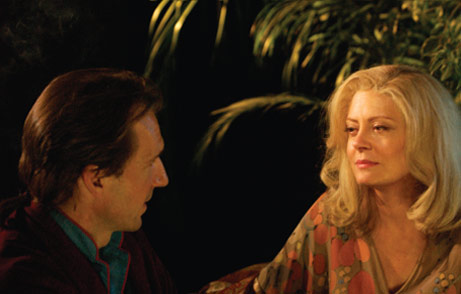
The film Rubinstein describes is Bernard and Doris, directed by Bob Balaban (Parents, The Last Good Time), which made its debut on HBO last month. Very nearly a two-handed game, with stars Susan Sarandon (Doris Duke) and Ralph Fiennes (Bernard Lafferty) appearing together in nearly every scene, it offers a fictionalized account of aging tobacco heiress Duke’s last years, focusing on a close but strictly-platonic relationship between the lady of the house and her butler in what could be considered a case study in how opposites not only attract, but also form into complementary colors.
Sarandon had appeared in a previous Balaban-directed project so she was approached early on. When Fiennes showed interest in the part of Bernard, the project, under the auspices of Kevin Spacey’s Trigger Street Independent, began to gel. “The wonderful cast being already in place is part of what got me so excited when I read the script,” Rubinstein recalls. “I had worked with producers Mark and Adam Kassen before, so they had me meet the director. Bob wanted to shoot [director Robert] Altman-style with the camera in constant motion, which we followed eighty percent of the time. We agreed that this was really going to be about supporting the performances, which was fine with me. By and large I don’t like setting things up so actors have to hit marks, because it seems to me they already have an awful lot to do and remember to sustain a performance.”
Trigger Street produced the film using a model not unlike the one pioneered by the New York-based InDigEnt [Independent Digital Entertainment], which allows filmmakers to retain creative control over a project by working within stringent budgetary controls. With |
| |
 |
|
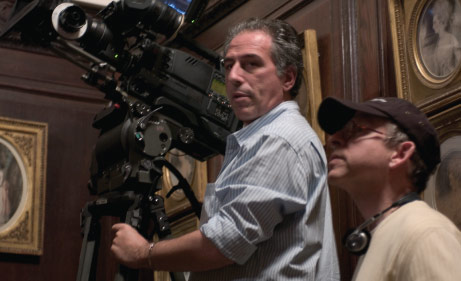
the whole film costing in the middle six figures, crews are small. “I used the company’s own equipment throughout, which included a [Panasonic] Varicam and P+S Technik’s Pro35 adapter for 35mm lenses, along with their Zeiss Super-speed primes.”
Rubinstein finds that the combination of prime lenses and adapter makes for a more-than-acceptable image. “Out of all my digital shooting experiences, this time out I have been able to achieve the most cinematographic look,” he says. “The depth of field and scale of 35mm lenses give a more film-like feel than HD primes, which remain somewhat hard-edged and stark, since the level of sharpness is beyond what the eye can see and is not always ideal. But the real difference I believe is due to the adapter, more specifically the texture of the matte glass in the adapter, which gives the image a certain softness that makes digital capture look very nice, so much so that I used no diffusion or filtration.”
Like Rubinstein’s other recent projects, 2006’s Puccini For Beginners and the upcoming The Funeral Party, Bernard and Doris also shot in the New York region. “Once I got the equipment, I went out six or seven times to shoot B-roll at our principal location, the Old Westbury Gardens, which stood in for the Duke house. There’s probably only thirty seconds of that footage in the final cut, but it gave me an opportunity to understand the camera, and that footage helped establish a sense of winter for certain parts of the film.”
The Westbury estate has been featured in a number of past films, including North By Northwest (shot by Robert Burks, ASC), Arthur (Fred Schuler, ASC), The Age of Innocence (Michael Ballhaus, ASC), Wolf (Giuseppe Rotunno, ASC) and American Gangster (Harris Savides, ASC). The entire film crew had to follow very strict rules while shooting there. “The place is a kind of museum now, so we could not touch the walls or the ceiling,” explains Rubinstein. “We couldn’t even touch the floor with our equipment. So that meant |
| |
 |
| |
putting cardboard under every light stand. Except for the bed, the piano and a table in the dining room, all the rest of the furniture had to be replaced, because we couldn’t touch any of that either.”
Restrictions were different in various parts of the house. “For one shot, an actor was allowed to walk through a room, but the crew wasn’t permitted to go inside. So we made the shot from outside, looking in. It was very peculiar.”
To retain director Balaban’s plan for keeping the camera in motion while adhering to the estate rules, more cardboard was needed wherever track would be placed. “So we put down cardboard, then hardboard, then sound blankets, and then the rails, before we could use the dolly,” Rubinstein explains. “On the ground floor I could use the Fisher 10, but upstairs, we were limited to a skateboard dolly.”
Large lights were also off-limits for the interiors. “I couldn’t put up anything like a cherry picker—not even scaffolding—plus I had to keep the big sources outside. When we shot on the top floor, I was permitted to put some equipment up on select spots of the roof, but everything else had to come from outside.” To deal with these restrictions, Rubinstein elected to carry an all-purpose lighting package, which helped facilitate when changes in weather turned sunny days into cloudy ones. “We were in a Nine-light situation a lot of the time,” Rubinstein elaborates. “I had a 12K, a 6K, a pair of 2.5Ks, two 1.2Ks and two 575-watt units. Then there were a couple of 5Ks, 2Ks, 1Ks, 500s, and 300s, plus some Kino Flos.”
Keeping the lights out of frame during the many tracking shots following Bernard and Doris through the house was problematic, so much so that Rubinstein tried to work as much as possible from whatever existing light was provided from the exterior. |
| |
 |
| |
“It was often really all about finding a way to get the most out of that light, then shaping it to fit the space on the interiors. Unless you have contrast on a digital image, the picture won’t look sharp. So making sure there was enough contrast on these lit-from-outside interiors was an issue.”
One of the cinematographer’s biggest challenges related to the aging of the two principals. “Susan’s character starts as a pretty good-looking woman who undergoes plastic surgery and holds her age for a time,” says Rubinstein. “But after her health begins to fail, she ages drastically.” Instead of employing prosthetics, older makeup tricks such as pulls were used to suggest changes in her appearance, and Sarandon herself was able to contort her body to suggest she had shrunk four inches. “It was amazing to see what she could do on her own, but all those subtle changes with wigs and makeup on the actors was demanding in terms of production time; the older the characters got, the more time was spent in makeup and less was available for shooting.”
Makeup artist Lynn Campbell aided Rubinstein, providing very welcome input regarding particular angles and lighting that allowed Sarandon to look most credible for that age in her character’s life. “In addition to letting Susan know how the light worked for the space she acted in, Lynn would tell me if I was making Susan look too good for a particular scene. I’d have to mess things up a little bit, which really ran counter to my way of thinking, let me tell you!”
When HBO decided to acquire the film, a few reshoots were in order, primarily in the need for some tighter close-ups. With the original location unavailable, production set up on a Brooklyn stage, where production designer Frankie Diago used flats and some leftover furniture to recreate the interiors. “I’ve never had to shoot pickups in such drastically different conditions, matching daylight-lit location interiors to in-studio close-ups.”
Complicating the reshoot was the fact that two different references existed for the location shoot. “I had the raw version, plus one with a postproduction color tweak that was probably done on an Avid,” says Rubinstein. “I wasn’t certain that look would be retained, as it was a kind of experiment, so I had to try to strike a balance between these two looks.” With gaffer Derek Gross unavailable, key grip Freddy Galfas gaffed the reshoots, with John Corso coming on to operate.
Another surprise came when HBO elected to go 16:9 for the aspect ratio, even though Rubinstein had composed for 2.35. “We hadn’t expected to debut on cable, but even so, opening up the top of the frame didn’t hurt us too badly, though a few times there were things made visible up above that had to be taken out digitally.” Rubinstein feels he met his various objectives on the project. “My goal throughout was to retain the premise that this was a very intimate story, voyeuristic, but not intrusively so,” he explains. “I also tried to remember that we wanted to feel a sense of opulence, but not to be overly concerned with it. Later on, somebody at HBO said the atmosphere of the film was one where you could feel wealth, and I take that as a compliment. Not just for the efforts of the camera crew, but for the work of the hair and makeup people, the production designer, costume designer Joseph G. Aulisi, and of course Bob Balaban and his wonderful cast.”
|
|
|
 |
|
|
 |
|
|
 |