For this month’s Tips and Tools, ICG Magazine polled leading manufacturers for their latest and most important lenses for everything from feature work to prosumer independents. Canon, Fujinon, Century/Schneider, Panavision, Cooke, Zeiss and P+S Technik have come up with what they feel is cutting-edge at this time in the industry—many of the products below are so new to the market, at the time of this writing, they were just being used on productions or announced.


We hope that these new tools will do what they are designed for
—making your jobs easier and more creative.


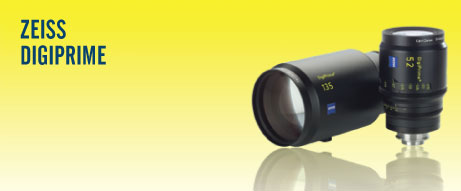
Early summer, 2008, is the date set for release of the newest in the Carl Zeiss DigiPrime lens line. The 135mm T-1.9 and 52mm T-1.6 lenses will join the DigiPrime family.

These two new lenses were built specifically for 2/3” three-CCD HD cinematography cameras. They feature the superior quality optical glass Zeiss has been known for, are precision engineered for performance and clarity. And, also feature standard-pitch zoom, focus and iris gears, brightly marked over-sized windowed cine scales, and highly accurate, individually calibrated focus scales.
These new lenses will be distributed through Band Pro Film & Digital Inc.

www.bandpro.com


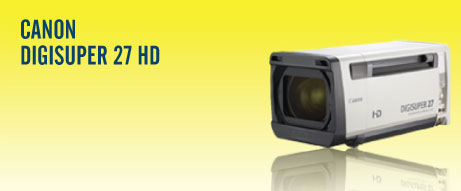
“The DIGISUPER 27 is the successor to the DIGISUPER 25xs, one of the most popular HD studio lenses,” explains Gordon Tubbs, director of the Broadcasting and Communications division of Canon USA. “It is the next step in HD studio lenses; wider, has a bigger zoom ratio and features newly developed multi-layer optical coatings that reduce ghosting and flaring.”

The new DIGISUPER 27 has a focal length of 6.5mm to 180mm. It offers an optional BWA-271 0.9x wide attachment, the industry’s first wide-angle attachment for an HD studio lens. The “zoom-through” wide attachment enables users to begin with a wide shot and go telephoto without negative effects in light transmission. The feature alters the range of the zoom on wide settings by ten percent toward the wide side, making the new zoom ranger 5.85mm to 162mm.

Improvements also include a servo-zoom speed of 0.5 seconds and a new optical remote-controllable macro-focus feature that allows the camera operator to perform macro focusing from the pan bar (helpful when shooting jewelry or small objects).
Canon DIGISUPER lenses incorporate the second-generation Digital Servo System, making zoom and focus precise and repeatable. It provides microcomputer compensation of lens focus-breathing, information display that enables the camera operator to select and customize zoom-servo settings and is equipped with virtual output.

www.usa.canon.com


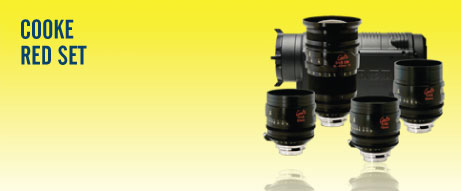
The Cooke RED for the RED ONE camera features a package of four standard Cooke S4/I lenses offering focal lengths from 15mm through 100mm, specially engraved with the red lettering.

The lenses incorporate metadata capture technology that can be read directly by the contacts of the RED camera lens mount.

The set includes the S4/15-40mm, T2.0 CXX Zoom lens, S4/50mm, T2.0 Prime lens, S4/75mm, T2.0 Prime lens, and the S4/100mm, T2.0 Prime lens.
These lenses are equipped with Cooke’s “intelligent” technology, enabling film and digital cameras to automatically record key lens and camera data for every film frame, which can then be provided digitally to post-production teams. The technology streamlines both production and post-production, saving time and cost and eliminating guesswork, and with more creative freedom. RED has built support for Cooke’s technology into the contacts of the RED lens mount, with no additional equipment needed.

www.cookeoptics.com


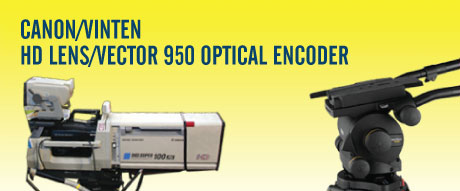
Two Canon field lenses, the DIGISUPER 100xs and DIGISUPER 86xs, are now compatible with the new Vinten Vector 950 Active.
“The exclusive technology collaboration between Canon and Vinten takes Canon’s Shift IS Image-Stabilizer system and makes it an even greater tool for camera operators when combined with Vinten’s Vector 950 Active head,” explains Canon USA’s Gordon Tubbs.

The combination of Canon IS system and Vinten Vector 950 pan/tilt head offers camera operators improved picture control and better performance in a smaller package. The combination allows for infinitely adjustable TF drag, tilt-axis deadlock, an illuminated leveling bubble and pan-and-tilt brake levers positioned for ease of use. The counterbalance system allows up to ±90º counterbalanced camera tilt.

The combination of the Canon DIGISUPER 100xs or 86xs long-field zoom lenses, which can capture rock-solid images in HD even at telephoto, with the Vinten head captures action like it has never been captured before. The Vinten-Canon technology collaboration debuted at the 2007 Super Bowl, where the two Canon cameras were coupled with the Vinten Vector 950s.

www.usa.canon.com


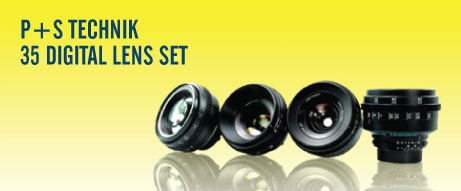
P+S Technik is best known for the MINI35 and PRO35 image converter, however the company offers a wide range of high precision optical equipment. The 35Digital Lenses were presented at NAB 2007 and quickly became popular in the professional cine world. The high quality lenses are based on Zeiss SLR lenses and work perfectly with the P+S Technik Image Converters. Because of the high approval, the 35D Lens Set will be extended in 2008.

Furthermore the lenses match perfectly with all P+S Technik products equipped with the Interchangeable Mount System. The system consists of an intermediate positive lock mount on camera side and various lens mount adapters. The IMS makes an easy and fast change between different lens mounts possible, without collimation, and is flexible for all different kinds of lenses. Since the launch of the MINI35, P+S Technik equips all its products with the IMS and offers the system as an open standard for other camera producers.

The Nikon Mount for the Interchangeable Mount System has been improved and is available. The Nikon Mount clamping mechanism has been reengineered: A new locking ring provides better stability especially when using a follow focus or lens control system. Due to the locking ring you have the possibility to fix the lenses firmly.

www.pstechnik.de


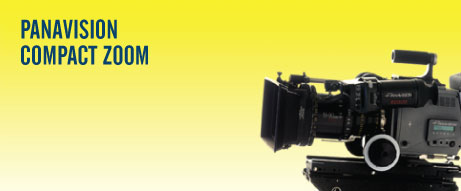
“Filmmakers are always asking us for smaller, lighter lenses,” says Bob Beitcher, President and CEO of Panavision, Inc. “With the PCZ, our goal was to provide a lens that met those objectives without loss in optical quality.”

The resultant PCZ, which will be available early 2008, provides a wide-range of commonly used focal lengths in a package about half the size and weight of comparable zooms. The PCZ allows selection of focal lengths between 19mm and 90mm without disrupting the momentum of the scene. The Panavision Compact Zoom maximizes contrast, resolution and field illumination, while minimizing breathing, veiling glare, ghosting, distortion and other aberrations. It also maintains constant focus and a T-2.8 aperture throughout the zoom range, and can be zoomed in-shot or used as a variable prime.

The new PCZ is eight-inches long, weights 7.3 pounds and can be used on dollies, remote heads, handheld and Steadicam shots. The maximum aperture is T-2.8 and close-focus to 2-1/4 feet. It features zero-backlash mechanics, important for follow focus. The ergonomic considerations include expanded dual-side scales and standard gear locations for focus, zoom and T-stop.

www.panavision.com


Schneider has recently designed two new fisheye lenses to work with the Panasonic AG-HVX200, as well as the DVX100 A/B camcorders. This will now allow users to capture ultra-wide field-of-view and pronounced barrel distortion.

These HD quality optics lock onto the bayonet mount at the front of the camcorder lens to provide an approximately 160º horizontal view (180º when measured diagonally). For reinforced support, it interfaces with existing 15mm standard rod systems.

The angle-of-view is designed for action sports, music videos, underwater photography—or dramatic impact shots in tight environments—where capturing the field-of-view is otherwise impossible.

www.schneideroptics.com


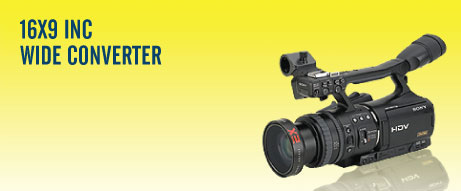
Compact HD camcorders such as the Sony HVR-V1U can now get 30% wider angles with the use of the new EX 0.7X wide converter from 16x9 Inc.
It matches to the 62mm threads on the front of the camcorder’s 3.9 – 78mm lens for more wide-range coverage than the lens alone.
The converter weights 13.75 ounces (390 grams) and has been engineered with a sleek three-element design with coated glass for clean high-definition pictures.

When installed, it modifies the camera’s 3.9-78mm lens to 2.73 – 54.6mm focal length. Or, using the 35mm SLR equivalent, the original 37.4 – 748mm lens broadens to 26 – 523mm. The lens retains its full zoom capability and there is no light loss or vignetting. The wide converter features an 82mm front thread that permits users to directly mount glass filters and other accessories in front of the optic. It is also fully compatible with mattebox systems.

www.16x9inc.com


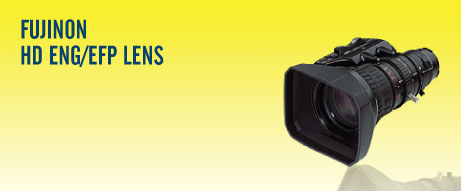
Many independent filmmakers are discovering that they can get good quality images with what the industry calls prosumer equipment, when cameras and lenses are designed with feature quality in mind. The combination of Fujinon’s Th17X5BRM HD ENG/EFP lens with its camera counterpart a JVC GY-HD110U 3-CCD ProHD camcorder is a perfect example.

The lens, featuring a high zoom range, close focusing and exceptional optical quality allowed director Elizabeth Reeder to capture images for the indie feature A Very Bad Day on a relatively small budget. “I’ve worked on television episodes that had a bigger budget then we did,” explains Reeder. However, to Reeder, the combination of the JVC camcorder and the Fujinon lens gave her a bigger-budget look.

Reeder put the camera and lens through the paces, dingy, low-light locations, interiors of silos, underground in sewage drains, trailers, without compromising the camera and lens. With either follow focus or manual, the lens responded quickly. Same with rack focusing. “We were able to use the lens in difficult situations and come out with shots that look like we were using a higher end camera and lens,” she adds.

www.fujinonbroadcast.com